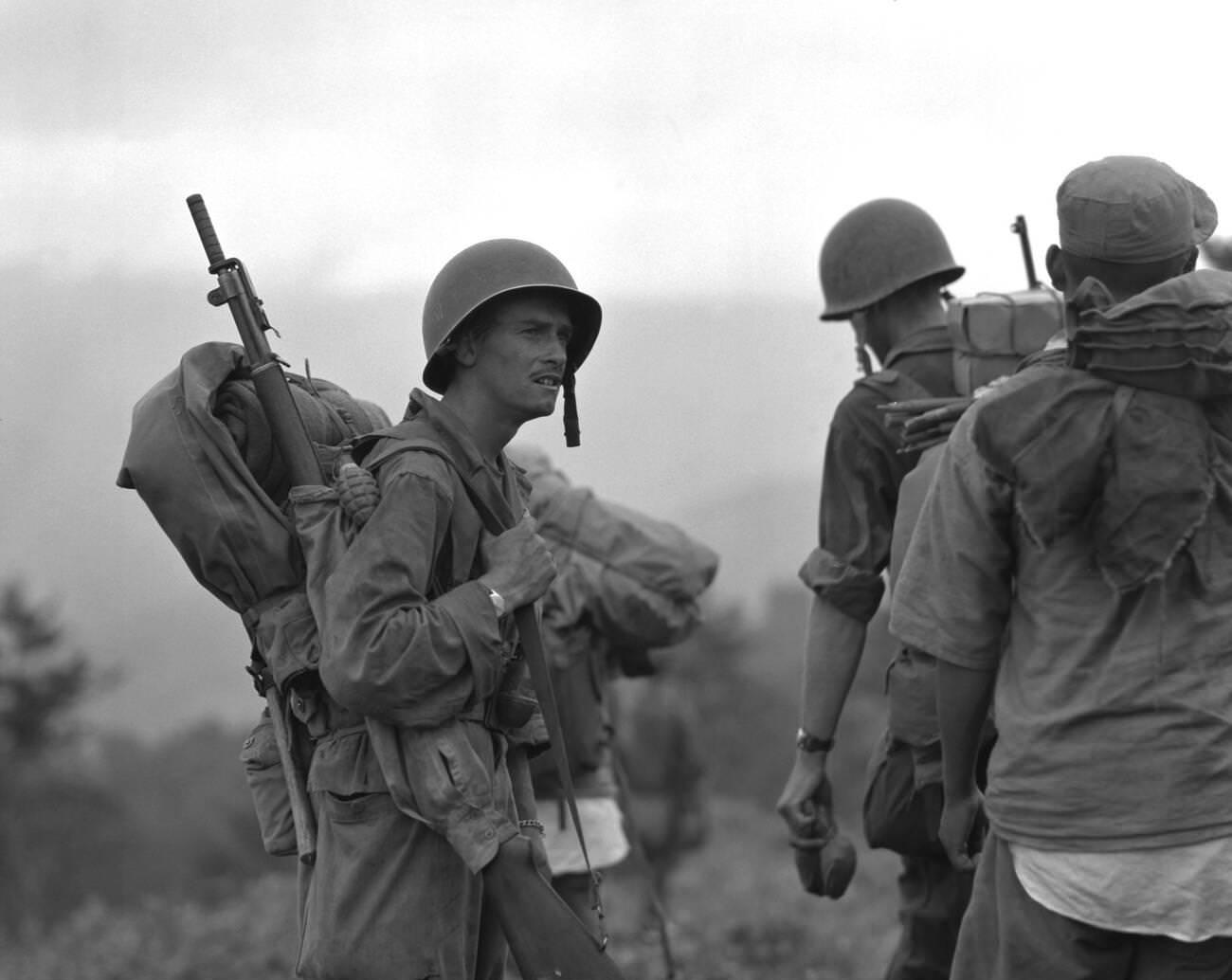
A French infantryman moves through the Korean landscape with an American-style steel helmet low on his brow and a heavy field pack riding high on his shoulders. The long rifle slung behind him, the layered straps, and the utilitarian cut of his clothing speak to a war fought on foot, where every march meant weight, weather, and fatigue. Behind him, other soldiers continue forward in the same direction, their silhouettes and gear forming a quiet rhythm of movement.
American supply and standardization shaped much of the United Nations effort in the 1950s, and the mix of nationalities could often be read in the kit as much as the languages spoken. Equipment issued or provided by U.S. forces—helmets, packs, webbing, and other essentials—helped allied units operate within a shared logistical system, even while they maintained their own traditions and tactical identities. In that sense, this scene is as much about coalition warfare as it is about one man’s loadout.
For readers interested in Korean War history and Cold War-era military photography, the details here reward a closer look: practical field gear, worn fabric, and the unposed concentration of soldiers on the move. The photo underscores the everyday reality of the conflict—long patrols, rough ground, and the constant necessity of carrying one’s world on one’s back. It also offers a reminder that “civil wars” in the mid-20th century often drew in international forces, turning local battles into global commitments.