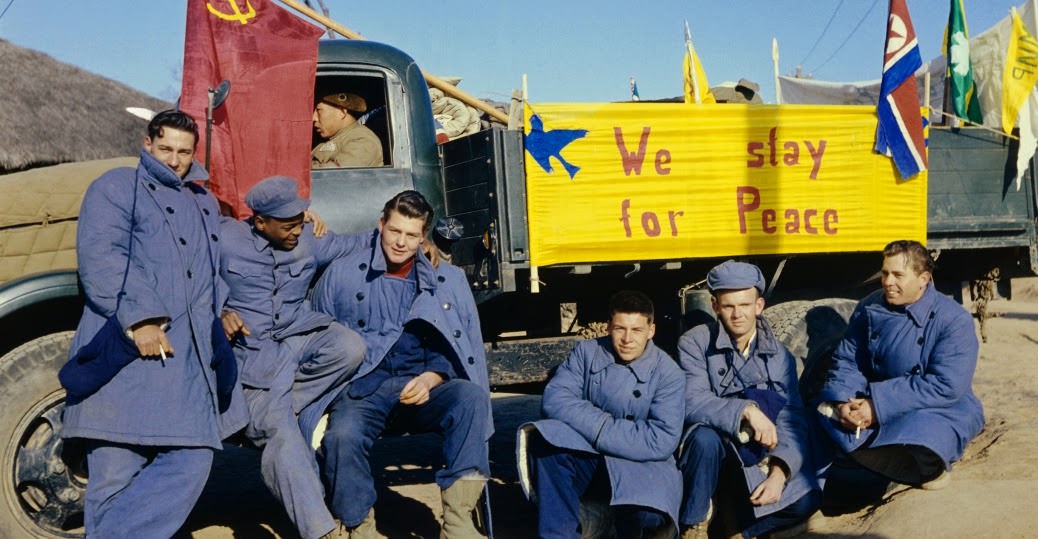
Against a bright yellow banner painted with the words “We stay for Peace,” a small group of American soldiers pose in heavy blue coats beside a military truck, cigarettes in hand and expressions that range from guarded to almost casual. Flags flutter above the vehicle, adding a charged political backdrop to what might otherwise read as a simple roadside portrait. The stark contrast between the relaxed posture of the men and the declarative slogan hints at the larger drama behind the moment.
The title points to one of the Korean War’s strangest postwar episodes: twenty-one Americans who refused repatriation when the fighting ended and instead chose a future beyond U.S. control. In the era’s propaganda battles, photographs like this could be framed as proof of conviction, coercion, or disillusionment—sometimes all at once—depending on who was holding the caption pen. Looking closely at the scene, the hand-painted sign and staged grouping suggest a message intended for audiences far away, not just the camera’s immediate witnesses.
Their story did not end with the banner; many of those who left for China eventually returned, and by the 1960s all but two had come back to America, carrying complicated memories and public scrutiny with them. That arc—from refusal, to relocation, to gradual return—makes the image more than a curiosity, anchoring it in Cold War politics, prisoner exchanges, and the human cost of ideological conflict. For readers searching Korean War history, American POW repatriation, or the rare case of defectors who later went home, this photograph offers a vivid doorway into a contested chapter of the twentieth century.