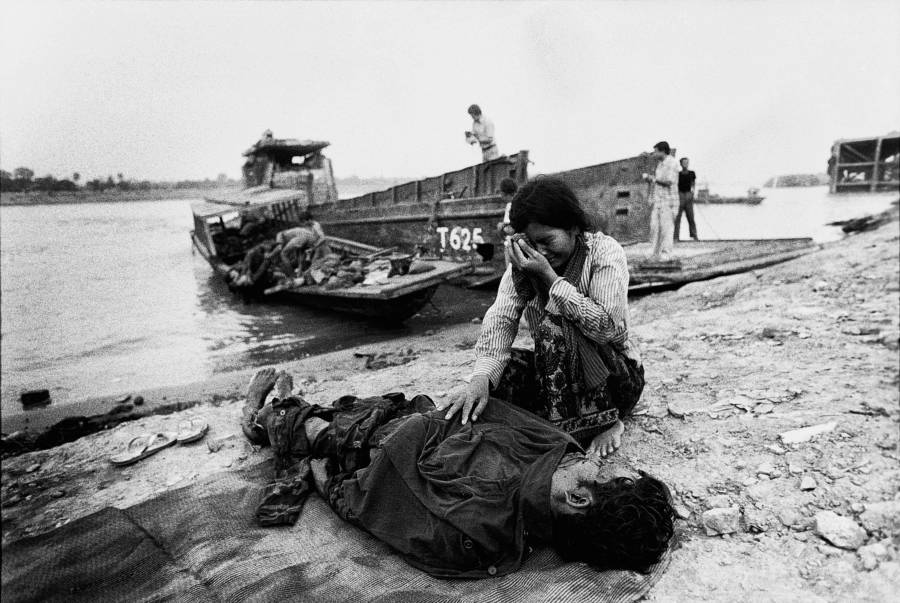
Grief collapses into the foreground as a woman kneels beside her husband’s body, one hand reaching toward him while the other covers her face. The ground is rough and littered with small debris, and the stillness of his form contrasts sharply with her trembling posture. Even without dialogue, the photograph communicates the raw immediacy of loss during the Khmer Rouge takeover of Phnom Penh in 1975.
Behind her, a wide river and working boats drift through the frame, their industrial shapes and scattered onlookers creating a chilling sense of ordinary movement continuing alongside tragedy. The shoreline feels exposed—no shelter, no privacy—turning personal mourning into a public scene. That stark juxtaposition is part of what makes this wartime image so enduring: the viewer is forced to notice how violence enters everyday spaces and rewrites them.
As a document of Cambodia’s civil conflict, the photo speaks to more than a single death; it hints at the countless ruptured families and abrupt disappearances that marked the era. It is a painful reminder that political upheaval is ultimately measured in human bodies and broken households, not slogans or maps. For readers searching for Khmer Rouge history, Phnom Penh 1975, or photographs of the Cambodian civil war, this image offers an unflinching window into the cost of power.