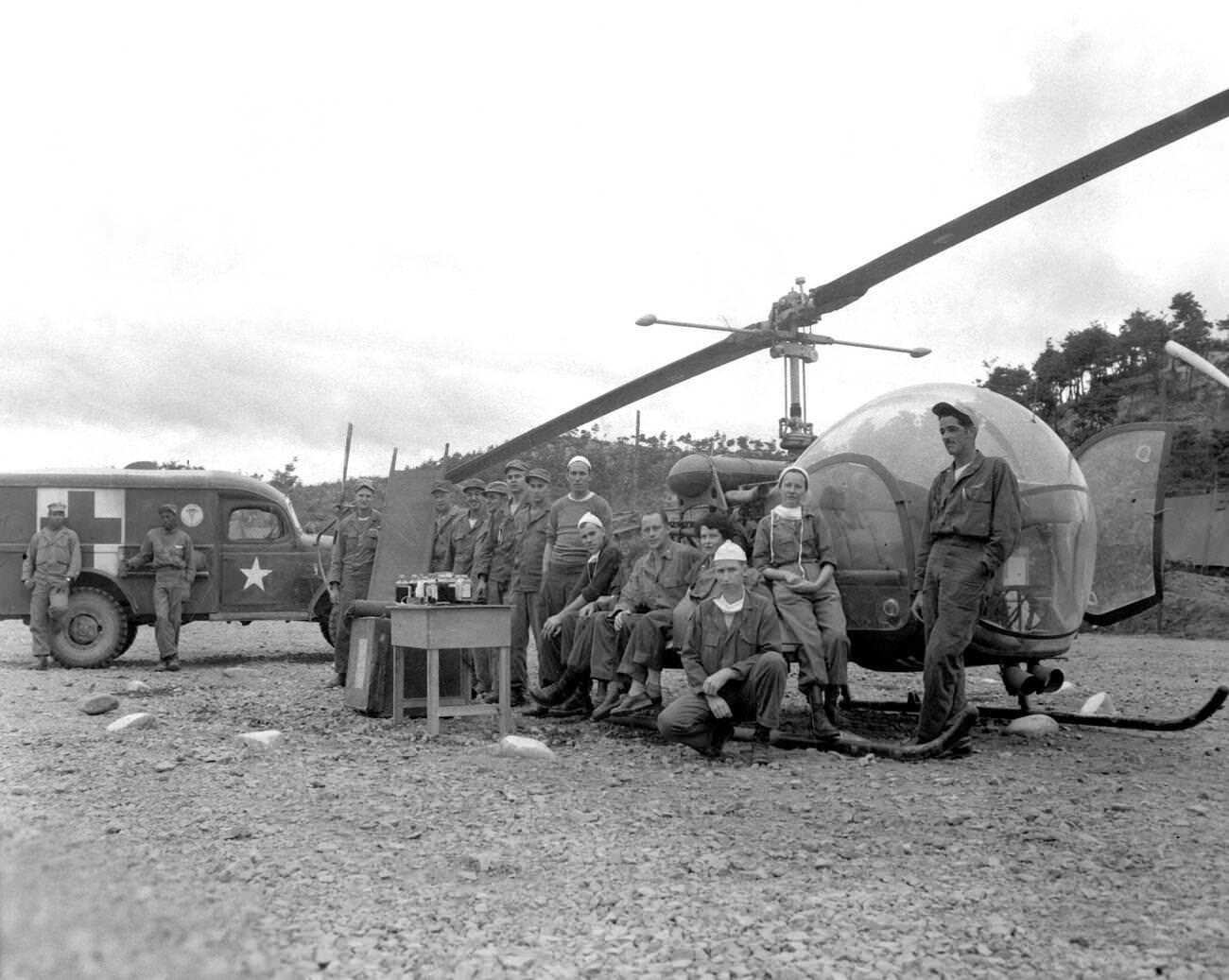
Beneath the long rotor blade of a Bell helicopter, a mixed group of U.S. Army medical personnel and aircrew gathers for a posed moment in 1951, their uniforms and workwear hinting at a day that has already been busy. The aircraft’s bubble canopy and exposed landing skids place the scene firmly in the early era of military rotary-wing aviation, when helicopters were still proving their worth beyond experimentation and demonstration flights. Nearby, an Army ambulance marked with a large star and medical insignia completes the visual shorthand of wartime medicine on the move.
Faces and postures tell a story of teamwork: some stand at attention, others sit or crouch close to the helicopter’s side, and a few lean with the relaxed confidence of people accustomed to field conditions. A small table set out in front of the group suggests an impromptu briefing, a shared meal, or the practical routines that fill the spaces between missions. The rough ground and distant hillside underscore how often military medical care had to adapt to temporary landing zones and makeshift work sites.
For readers interested in U.S. Army history, Korean War–era technology, and the evolution of combat casualty evacuation, this photograph offers a grounded look at how air and medicine began to merge into a new system of rapid response. The Bell helicopter stands as more than a backdrop; it represents a turning point in military logistics and emergency care, when vertical lift could bridge the gap between remote front lines and treatment. Preserved as a simple group portrait, the image quietly conveys the human labor behind early helicopter operations—pilots, crew, and doctors working side by side to move patients and save time when minutes mattered.