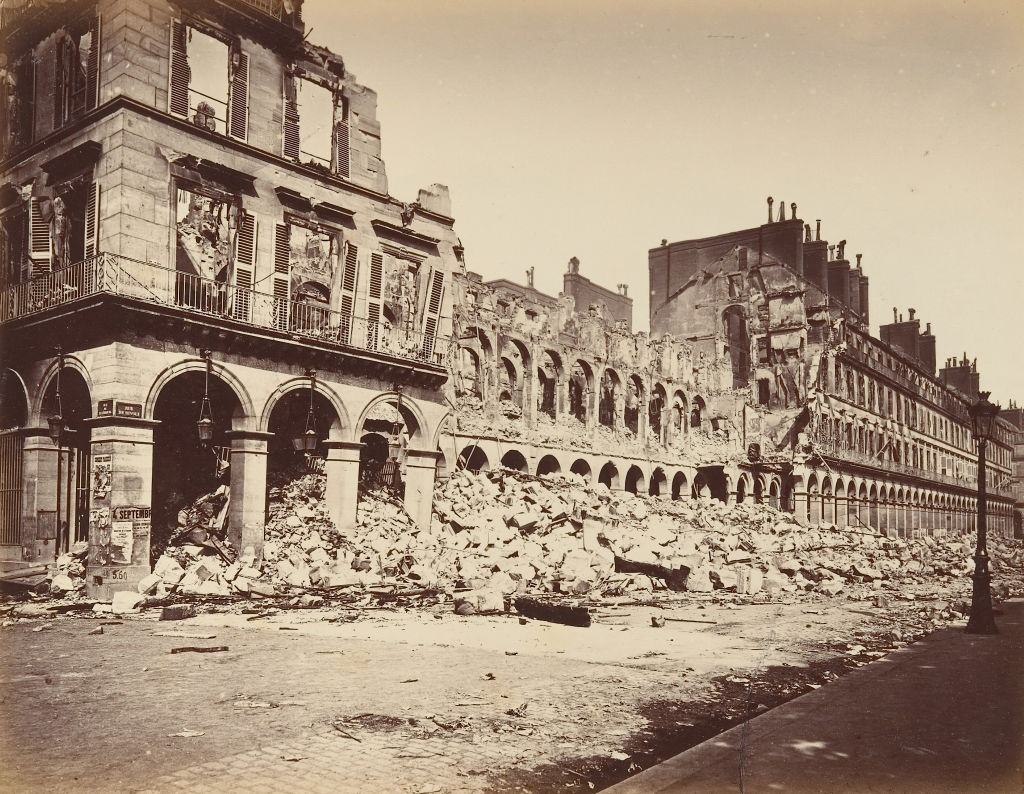
Across a broad stone arcade, the Finance Ministry stands hollowed out by fire, its long façade reduced to a jagged rhythm of arches and broken window bays. Shutters hang askew, upper floors are opened like a cutaway, and the street in front is choked with masonry—an uneven sea of rubble that pushes right up to the curb. The exterior view emphasizes scale: what was designed to project order and permanence now reads as a ruin laid bare.
The eye drifts from the surviving corner pavilion to the collapsed midsection, where interior walls and scorched beams peek through the gaps like exposed ribs. Even without close detail, the damage suggests more than an accidental blaze; it looks like the aftermath of urban fighting, the kind of destruction associated with civil wars and political upheaval. A quiet emptiness settles over the scene, with no crowds or rescue work visible—only debris, soot, and the hard geometry of stone.
As a historical photo labeled “Finance Ministry, Burned. Exterior View, 1871,” this image offers a stark record of how conflict can target the institutions that manage a nation’s wealth and administration. For readers exploring 19th-century unrest, government buildings, and wartime damage to cities, the photograph functions both as documentation and warning, preserving the moment when bureaucracy’s grand architecture met the chaos of flames. It invites reflection on what had to be rebuilt afterward—walls and ledgers alike—and what losses never appear in the ledgers at all.