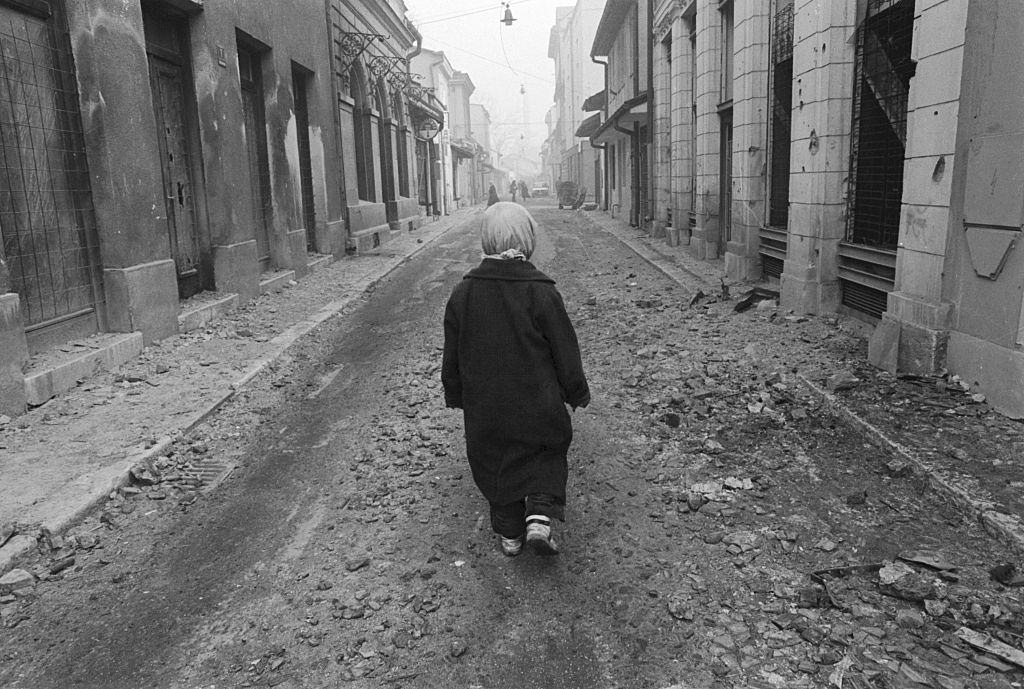
Down a narrow street in Sarajevo’s Old Town, a small figure moves forward with measured steps, wrapped in an oversized coat and a head covering that reads as both practical and protective. The road beneath him is littered with broken stone and debris, and the air feels emptied out—only a few distant silhouettes interrupt the long corridor of buildings. Overhead wires and old street lamps pull the eye toward the vanishing point, turning an ordinary walk into a tense passage through a city under strain.
Scars of civil war are written into the architecture on either side: shuttered storefronts, pocked facades, and battered edges where daily life once pressed close to the street. The perspective emphasizes how exposed a child can be in an urban landscape shaped by conflict, where open space offers little shelter and every corner suggests risk. Even without naming a specific moment, the photograph evokes the rhythms of survival—moving quickly, staying small, and learning routes that avoid danger.
For readers searching stories of Sarajevo during wartime, this historical photo offers a stark, human-scale view of what “surviving” can mean for a 10-year-old Muslim boy in the Old Town. It isn’t a battlefield scene; it’s a street scene, and that is precisely its power, reminding us how civil wars remake the most familiar places into uncertain terrain. The boy’s solitary walk becomes a quiet testimony to endurance, childhood disrupted, and the resilience of those who kept going through shattered streets.