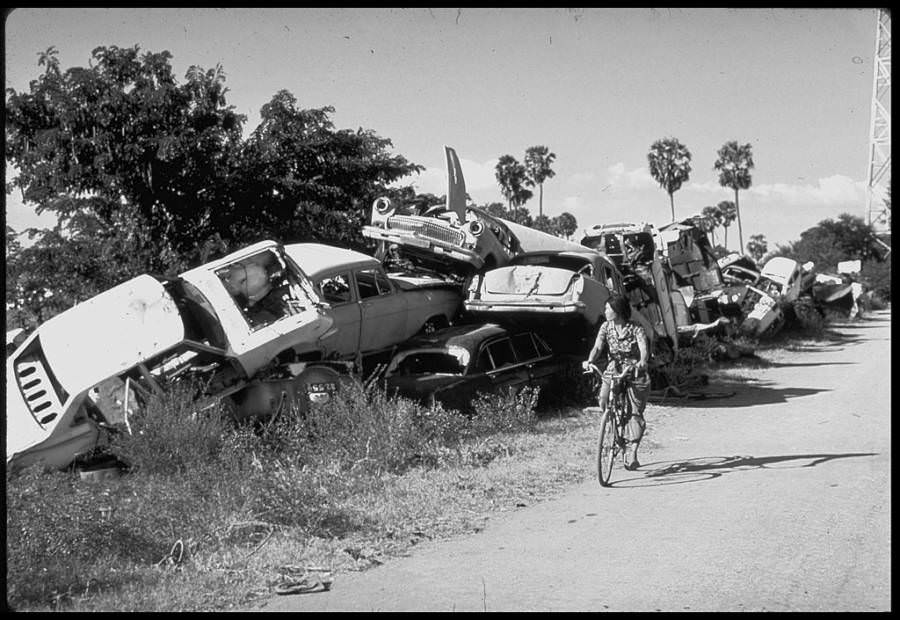
Along a sunlit roadside, a woman pedals a bicycle past an unsettling ridge of wrecked automobiles, piled and rusting like a deliberate barricade. The frame contrasts quiet motion with violent stillness: a narrow strip of pavement, scrubby grass, and palm trees beyond, while the skeletal cars lean at odd angles as if discarded in haste. Her steady ride draws the eye forward, emphasizing how ordinary life continued even when the landscape had been remade by upheaval.
The title’s reference to 1979 and the Khmer Rouge adds grim context to the scene, where cars become more than broken machines—they read as political trophies and warnings. In revolutionary Cambodia, motor vehicles were often treated as evidence of “bourgeois” status, objects to be seized, abandoned, or destroyed as society was forced into radical reordering. Seen this way, the stack of mangled bodies and shattered windows is propaganda made physical, a roadside monument to deprivation and control during a period of civil war and its aftermath.
What lingers is the human scale: one cyclist navigating past the ruins of a modernity that has been publicly rejected. The image offers a stark visual essay on class ideology, forced austerity, and survival, making it a powerful addition to any collection exploring Khmer Rouge history, Cambodia in 1979, and the broader story of Southeast Asian conflict. For readers and researchers, it invites closer looking at the small details—how people moved, what was left behind, and how the road itself became a witness to political violence.