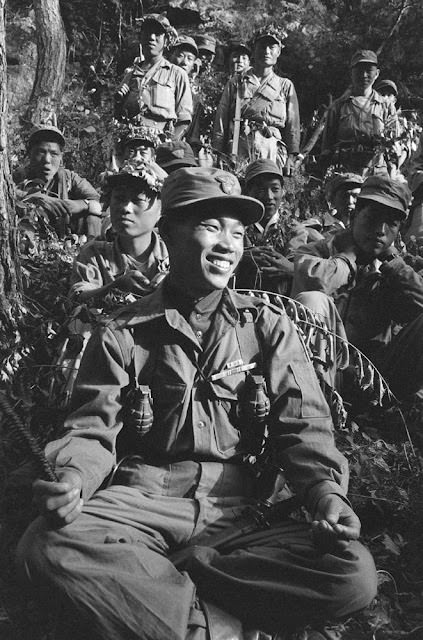
Relaxed in the shade and surrounded by brush and rock, a group of South Korean troops pauses long enough for the camera to find them. The foreground soldier leans back with a broad, unguarded smile, his uniform neat and his grenades hanging visibly at the chest, while others sit and stand behind him in layered ranks. Faces turn in different directions—some curious, some tired, some watchful—suggesting a brief lull rather than a staged portrait.
Details in the scene hint at the practical realities of soldiering in 1952: field caps pulled low, standard-issue gear strapped close, and rifles held upright or at rest. The natural terrain and tight clustering suggest men taking cover or regrouping during movement, with the hillside vegetation framing them as much as any backdrop. It’s an intimate wartime moment where camaraderie and alertness share the same space.
For readers searching Korean War history photographs, this image stands out for its humanity as much as its military context, capturing morale, fatigue, and routine in a single frame. The title, “South Korean troops, 1952,” places it in a pivotal year of the conflict, when prolonged fighting made ordinary pauses like this especially precious. Seen alongside the theme of civil wars and divided societies, the photo invites reflection on how national struggles are carried not only in battles, but in the expressions and endurance of the people asked to fight them.