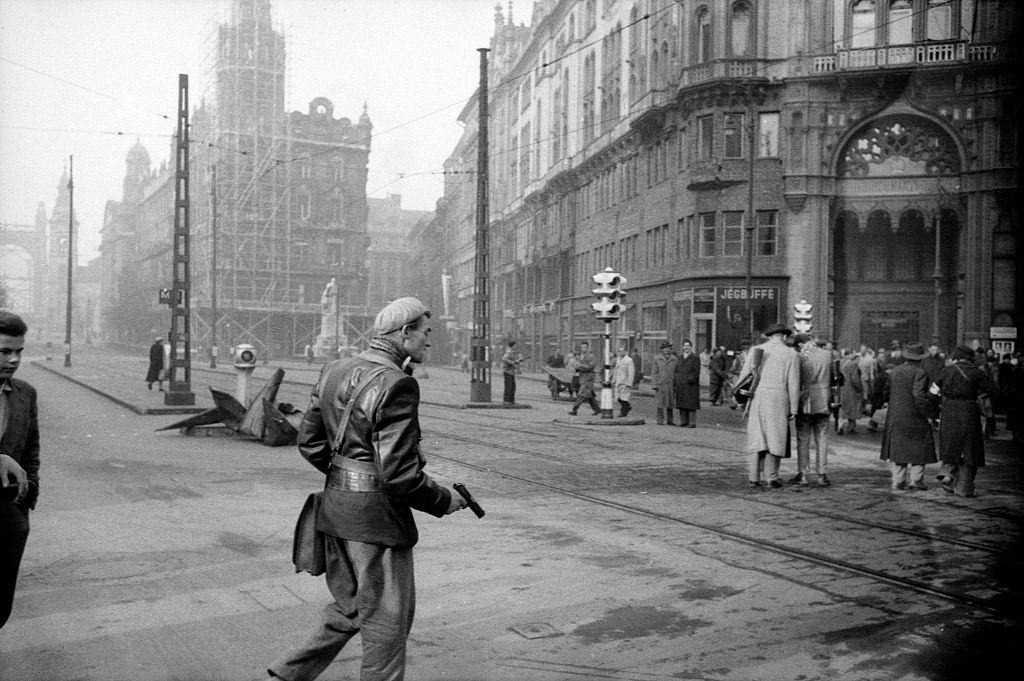
Late October 1956 finds Budapest caught between routine city life and open revolt, and the street scene here carries that tension in every direction of the frame. Tram tracks cut across a wide intersection where scattered pedestrians watch and wait, while a lone armed figure moves through the foreground with urgent purpose. Behind him, the long façade of a grand building looms over a crowd gathered near the corner, as if the familiar architecture itself has become a witness to history.
Eye-catching details ground the moment: traffic lights stand over a roadway that looks partially blocked, and anti-vehicle obstacles sit low on the pavement, hinting at hurried defenses built from whatever was available. A distant structure appears shrouded in scaffolding or repairs, adding another layer of disruption to an already unsettled cityscape. Coats, hats, and clustered body language suggest citizens navigating uncertainty—some moving on, others pausing to read the mood of the street.
The title’s date, 29th October 1956, places the photograph within the Hungarian Revolution, when rebels and ordinary residents shared the same streets under rapidly shifting control and rumor. Rather than a staged battlefield, it shows civic space turned contested ground, where the everyday—public transport lines, storefronts, street corners—becomes inseparable from armed resistance. For readers exploring Budapest 1956, civil conflict in urban Europe, or the lived experience of revolution, this image offers a stark, street-level view of a city holding its breath.