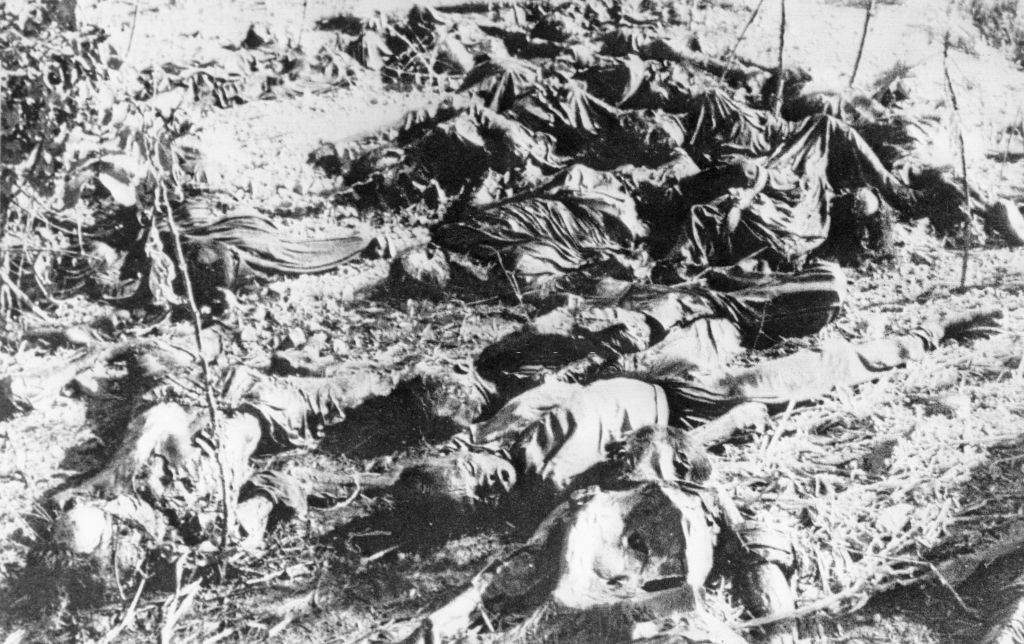
Across a rough patch of ground, bodies lie in dense rows, their clothing still clinging as the earth and debris gather around them. The stark monochrome reduces the scene to harsh contrasts—fabric folds, limbs at awkward angles, and the uneven texture of soil—leaving little room for distance or abstraction. It is an image of aftermath rather than battle, where the violence has already passed and the evidence remains.
Set in Cambodia, about 30 kilometres north-west of Phnom Penh on 28th February 1979, the photograph is tied to a prison operated under the former Khmer Rouge government. In the wake of civil war and regime collapse, such sites became grim landmarks in a landscape of shattered institutions and mass displacement. Photographs like this circulated as proof and warning, documenting what survivors and investigators would later describe in testimony, reports, and memorial records.
For readers searching the history of the Khmer Rouge, Cambodian civil wars, and the discovery of prison atrocities near Phnom Penh, this frame offers an unfiltered, difficult point of entry. The absence of identifiable faces or markers does not soften the message; instead, it underscores how quickly individuals can be reduced to anonymous casualties when state violence and conflict converge. Remembering these scenes matters—not for sensationalism, but to keep the historical record anchored in what was done and what was found.