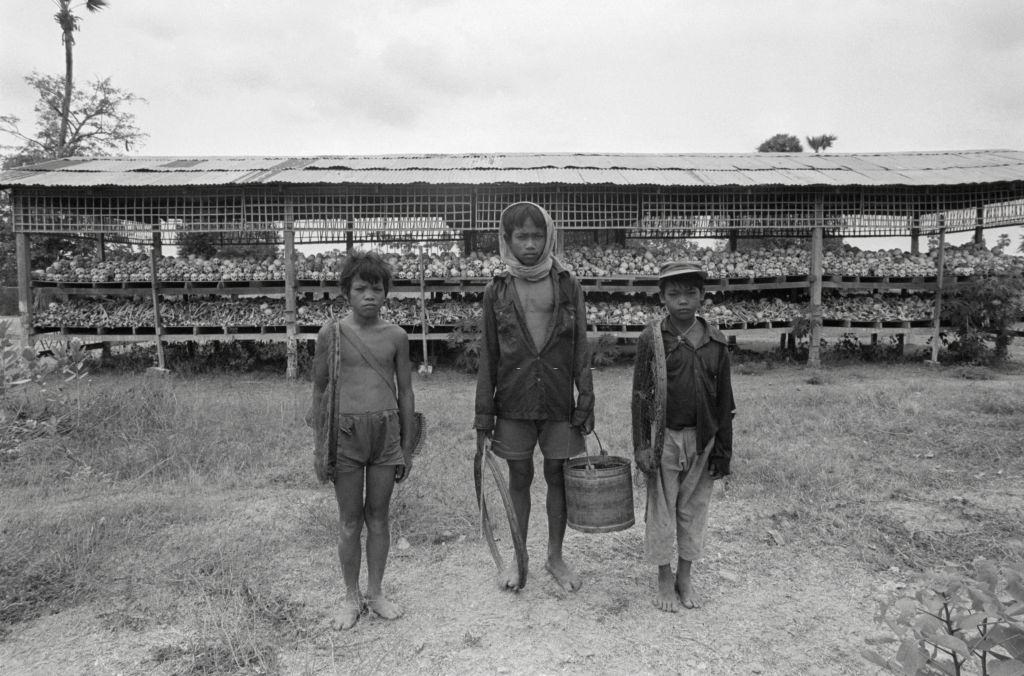
Three boys stand barefoot on a patch of scrubby ground, their faces set with the kind of stillness that war leaves behind. One holds a metal bucket; another grips a long, curved tool, everyday objects that feel out of place against the heavy silence of the scene. The camera keeps them in the foreground, yet the eye is drawn past them to a low hut that turns ordinary rural architecture into a marker of catastrophe.
Behind the children, shelves packed with human skulls and bones stretch the length of the structure, stacked in rows like grim inventory. The hut’s open sides and corrugated roof offer no dignity, only exposure—evidence arranged for viewing at the Choeung Ek extermination camp, a site associated with mass graves and the aftermath of Cambodia’s civil wars. In this stark composition, innocence and atrocity occupy the same frame, forcing a confrontation with how quickly a landscape can be made into a killing ground.
Even without a specific date pinned to it, the photograph reads as testimony: a record of survivors living alongside physical proof of the dead. For readers searching the history of Cambodia, the Khmer Rouge era, or Choeung Ek, the image underscores what memorials attempt to hold—memory made tangible, unbearable, and necessary. It asks us to look carefully, not for spectacle, but for the enduring human cost carried by the living in the shadow of mass violence.