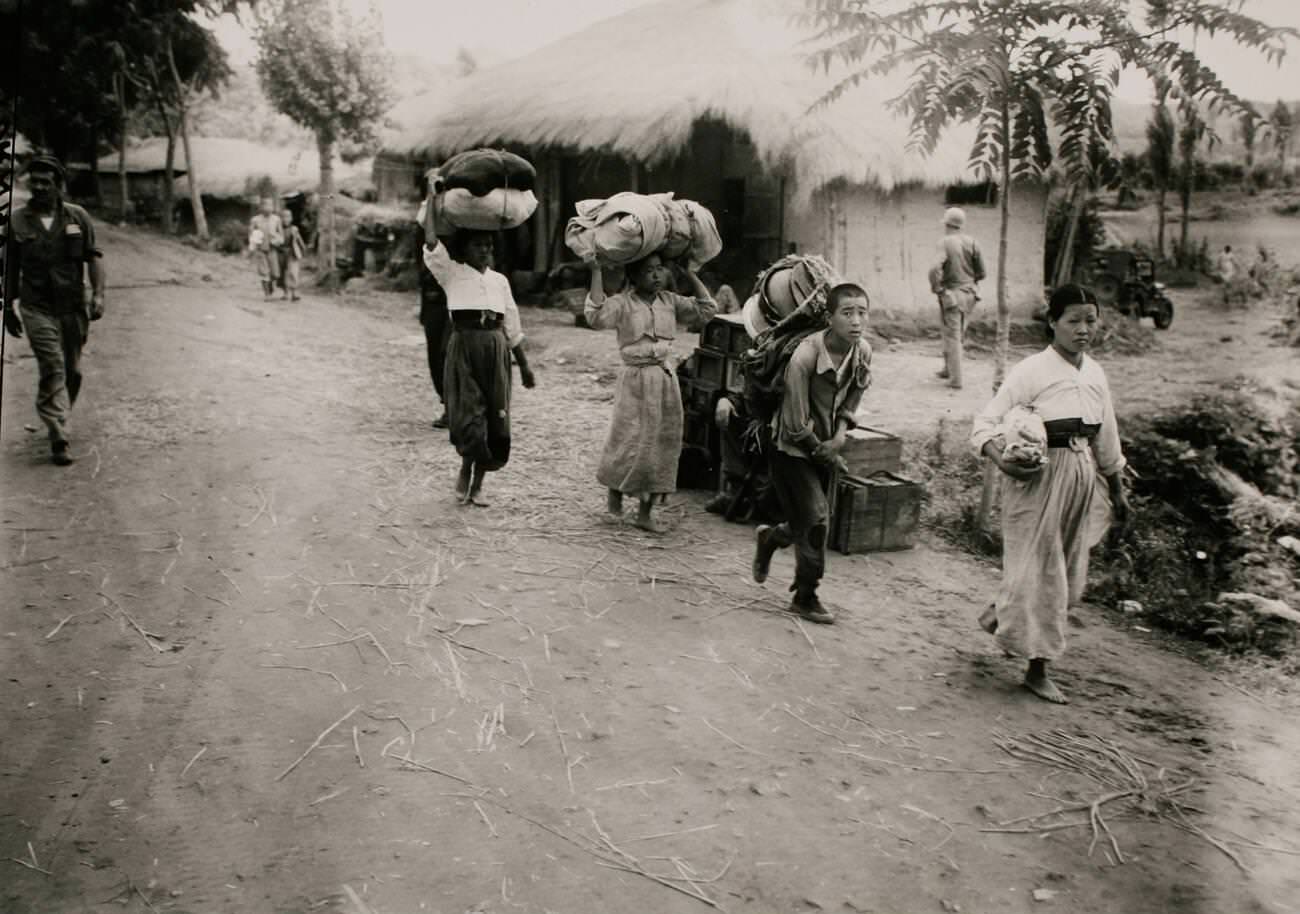
Along a dusty road lined with thatched-roof homes and sparse trees, civilians move with the urgency of people who cannot afford to linger. Bundles are balanced on heads, crates are dragged or carried, and a small handcart is piled high with household goods—portable fragments of a life being abandoned. The scene is plain and rural, yet the strain in body language turns it into a powerful record of flight.
The title places these travelers in 1950, during the opening phase of the Korean War, when the conflict between South Korea and communist-led North Korean invaders triggered mass displacement. In the foreground, women in traditional dress and a boy burdened with luggage convey how war collapses normal roles and forces entire families onto the road. Soldiers appear at the edge of the frame, a reminder that this is not ordinary migration but a civilian exodus shaped by rapidly shifting front lines.
For readers exploring civil wars and refugee history, this photograph offers more than a wartime snapshot—it preserves the everyday logistics of survival: what can be carried, what must be left, and how fear reorganizes communities overnight. The simplicity of the setting emphasizes the human cost of the 1950 Korea conflict, when countless people fled southward with little certainty of return. As an SEO-friendly historical image of Korean War refugees, it invites reflection on displacement as a recurring feature of modern warfare.