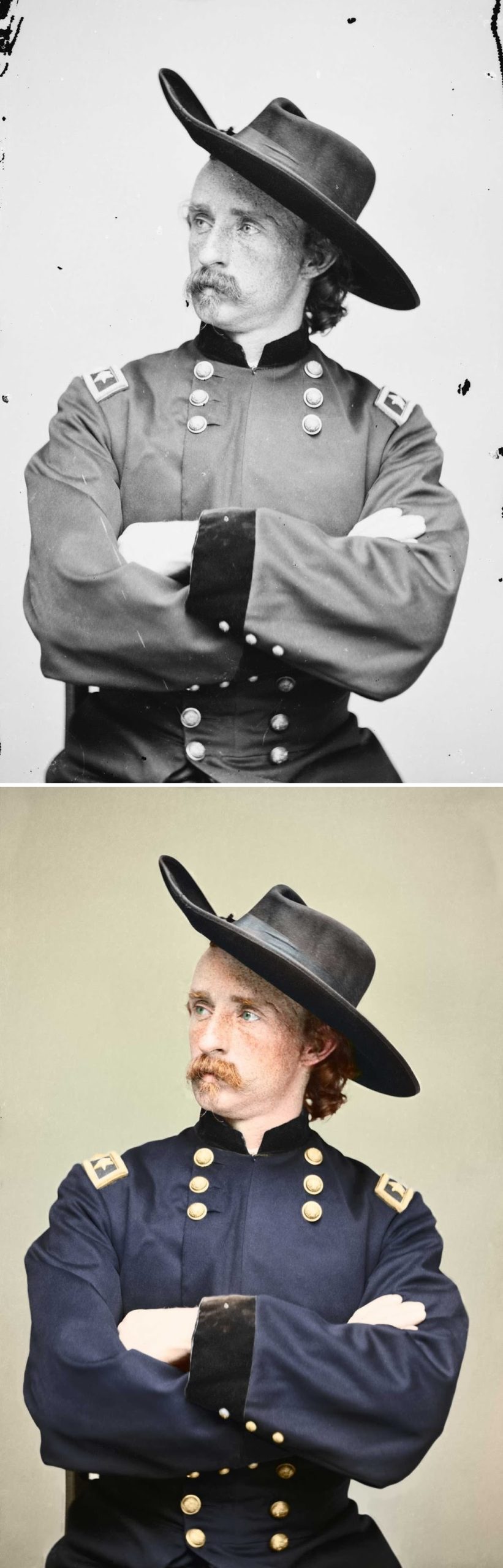
Arms folded and gaze turned slightly away from the camera, Maj. Gen. George A. Custer is presented in a poised studio portrait that feels both theatrical and controlled. The broad-brimmed hat, prominent mustache, and crisp Federal Army uniform—buttoned high at the collar with shoulder insignia visible—create a striking silhouette against a plain backdrop. With little scenery to distract, the viewer’s attention is pulled to posture, uniform details, and expression, the essentials of a Civil War-era officer’s public image.
Dated in the title to 1865, the portrait sits at a moment when the Civil War’s end was reshaping reputations as quickly as it reshaped the nation. Photographs like this were more than personal keepsakes; they were instruments of memory, meant to circulate and to fix an officer’s authority in the public mind. Even the deliberate turn of the head and the firm set of the shoulders suggest a man accustomed to being watched, judged, and remembered.
For readers exploring Civil Wars history, this image offers a close look at how leadership was staged in the nineteenth century—through dress, bearing, and the careful economy of a studio setting. The post title anchors the identification as George A. Custer and emphasizes his status in the Federal Army, making the photograph an ideal companion for discussions of wartime portraiture, military rank, and the visual culture of the era. Whether viewed in its original monochrome or a later colorized rendition, the portrait remains a vivid window into how the war was recorded one face at a time.