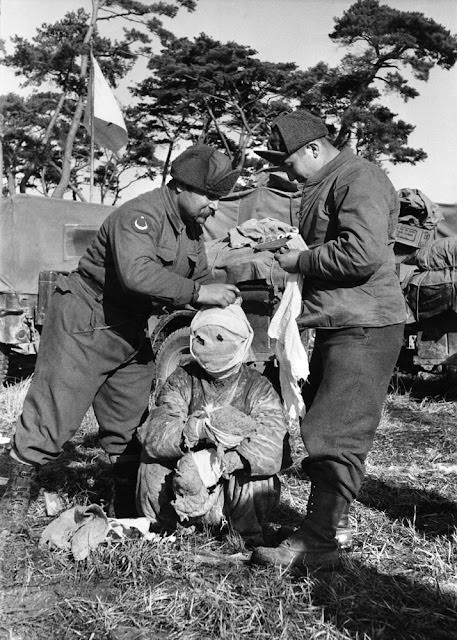
Beneath a stand of wind-swept trees, two Turkish soldiers work with quick, practiced care as they tend to a seated prisoner whose head and hands are heavily wrapped in bandages. The men lean in close, one steadying the injured captive while the other prepares fresh cloth, turning the moment into something quieter than the surrounding wartime setting. Behind them, a military vehicle and stacked gear anchor the scene in the everyday mechanics of a campaign—transport, supplies, and the constant pressure of readiness.
Uniform details and field equipment pull the viewer into the practical realities of 1951, where treatment often happened wherever there was room to kneel. The prisoner’s posture suggests exhaustion and pain, yet also a kind of enforced stillness, while the soldiers’ attention stays fixed on the basic work of stopping bleeding, securing dressings, and preventing infection. It’s a rare glimpse of conflict seen not through gunfire, but through hands, fabric, and the urgent improvisation of frontline care.
War photography often emphasizes victory or defeat, but images like this highlight the complicated human terrain in between—duty, control, and medical necessity intersecting in a single frame. For readers searching the history of Turkish soldiers, prisoners of war, and battlefield medical treatment, this photograph offers a stark reminder that survival could depend on acts performed by an enemy’s hands. Set against the broader theme of civil wars and postwar turmoil, it invites reflection on how rules of war, compassion, and pragmatism played out far from official statements and tidy narratives.