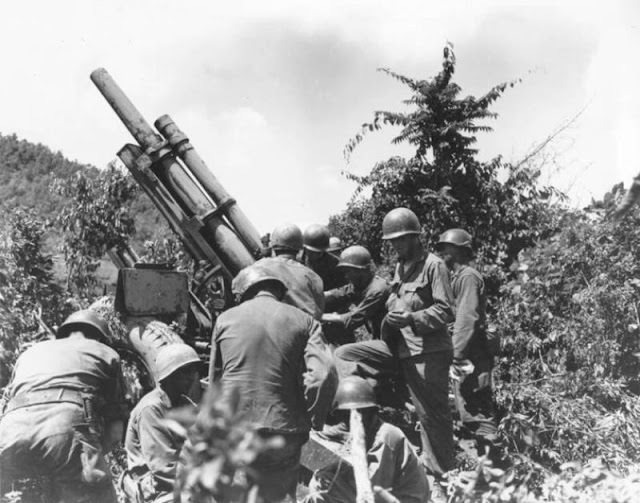
Tucked into scrubby cover along the Kum River, a U.S. howitzer crew works in tight quarters as the gun’s long barrel rises above the brush. Steel helmets and field gear blend into the rough hillside, while the artillery piece dominates the frame, angled upward as if already tracking a distant target. The terrain looks uneven and improvised, suggesting a position chosen as much for concealment as for a workable line of fire.
What stands out is the teamwork: several soldiers cluster around the breech and controls, others crouch nearby, each man focused on a specific task in the firing sequence. The compact scene hints at the constant rhythm of artillery operations—aiming, loading, relaying orders—carried out under pressure and often out of sight of the front line. Vegetation presses in on all sides, emphasizing how these gun positions were frequently carved from whatever landscape was available.
As a historical photo from the 1950s Korean War era, this view near the Kum River underscores the importance of field artillery in shaping battles through sustained support and long-range fire. It also offers a grounded, human-scale look at the daily labor behind big operations: mud, foliage, heavy metal, and coordination. For readers searching for Korean War history, U.S. Army howitzer positions, or wartime artillery photos, the image provides a vivid snapshot of a moment when geography and gunnery met on a contested river line.