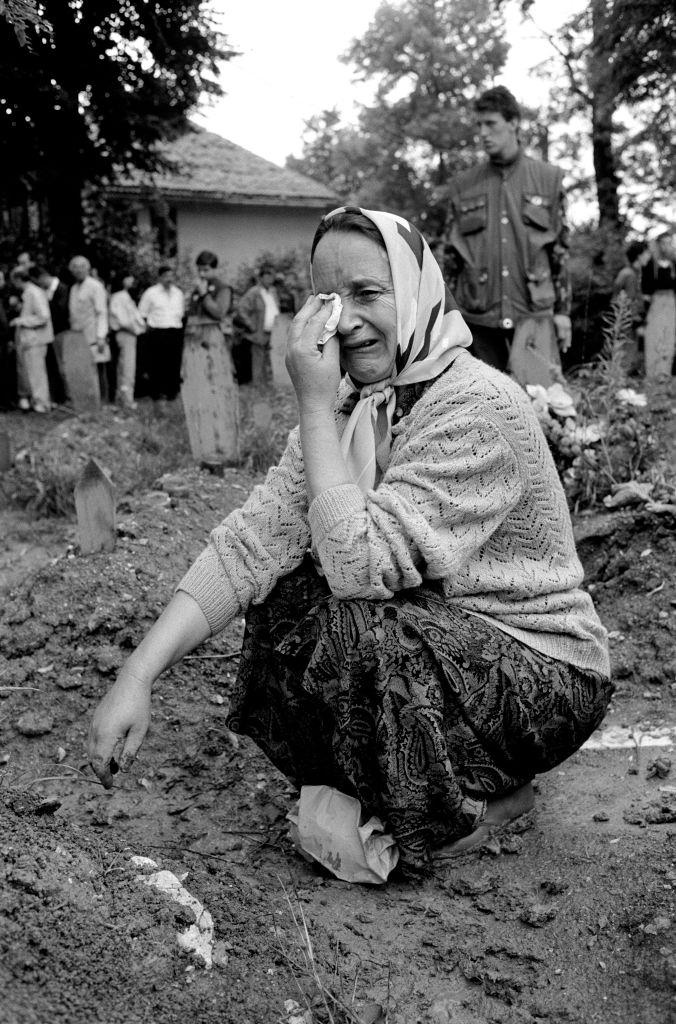
Kneeling in the churned earth of a Sarajevo cemetery, a woman presses a tissue to her eye, her headscarf framing a face tightened by grief. The fresh mound at her knees speaks to how recently the burial ended, while simple markers and scattered stones suggest a burial ground under strain. Behind her, onlookers stand in a loose line, their distance and stillness adding to the heavy quiet that follows a funeral.
Taken in 1994, the scene belongs to the era of the Bosnian War, when Sarajevo became synonymous with siege, loss, and civilian endurance. The woman’s posture—low to the ground, one hand touching the soil—turns mourning into a physical act, as if memory must be anchored to the place where a loved one now lies. Even without visible weapons or ruins, the photograph communicates a civil war’s most intimate consequence: families forced to say goodbye amid uncertainty.
For readers exploring Balkan history, Sarajevo in the 1990s, or the human cost of civil wars, this image offers a stark reminder that conflict is measured not only in headlines but in graves and broken routines. The cemetery setting, the gathered witnesses, and the solitary focus of the mourner capture a moment that is both private and public, shaped by communal tragedy. It is a photograph that asks us to linger on what war leaves behind—silence, soil, and the work of grieving.