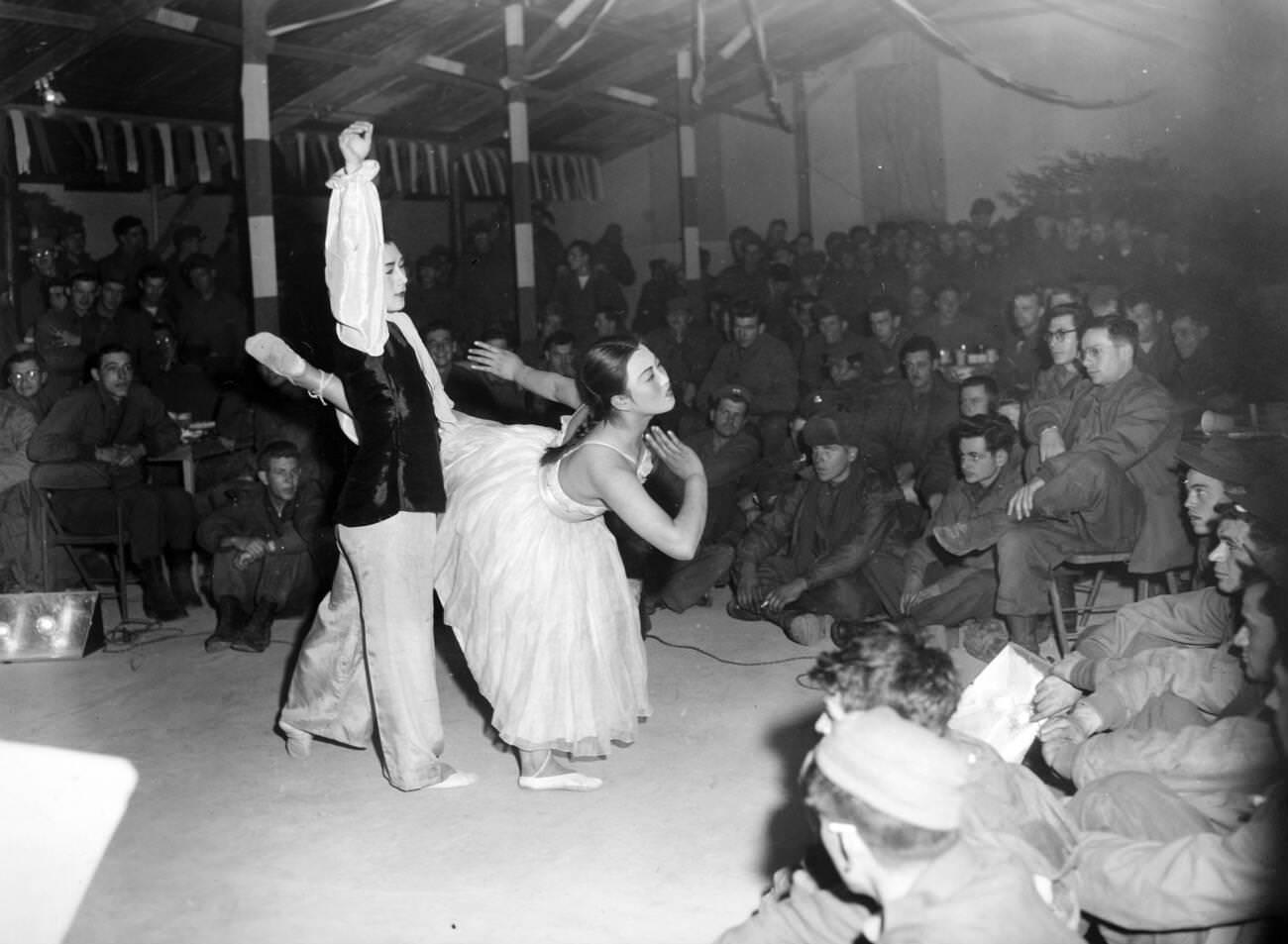
New Year’s Eve in Pusan, 1950, brought an unexpected pause in the harsh tempo of the Korean War as UN forces gathered for a special show. Inside a crowded hall, rows of uniformed men sit shoulder to shoulder, their attention drawn away from briefings and billets toward a small performance space. The title’s promise of entertainment is felt in the room’s packed stillness, where the ordinary routines of wartime briefly give way to anticipation.
At center stage, two dancers hold a poised moment—one lifted in a crisp, theatrical stance, the other leaning forward with balletic grace, skirt fanned as if caught mid-breath. The performers’ costumes and careful choreography contrast sharply with the utilitarian setting and the soldiers’ heavy field clothing. Faces in the audience tilt toward the movement, some intent, some weary, all momentarily united by a shared spectacle.
Such scenes matter in military history because they reveal how morale was maintained alongside operations, especially during the winter of 1950 when uncertainty hung over the peninsula. The photograph preserves a human detail often lost in campaign narratives: the deliberate creation of community through music, dance, and laughter in a temporary home far from home. For readers exploring Pusan, UN troops, and the Korean War’s lived experience, this New Year’s Eve performance offers a rare glimpse of resilience framed by culture and camaraderie.