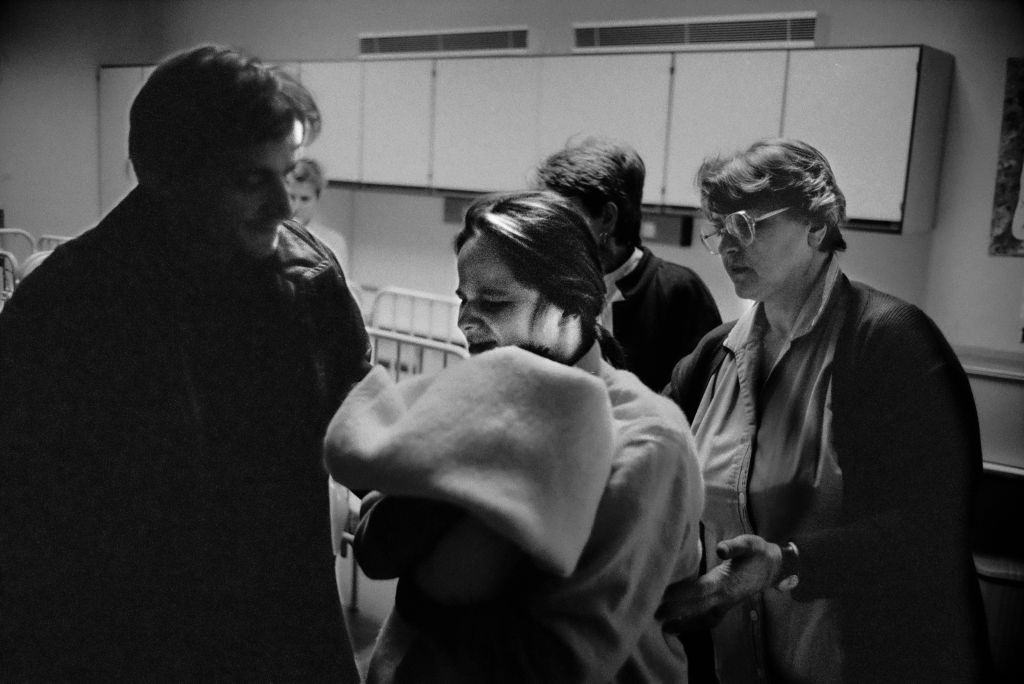
In a dim, crowded room that feels more like a makeshift ward than a place of comfort, a mother folds her body around her injured child, pulling a blanket close as if warmth alone could keep danger out. The adults around them hover in tight proximity—one figure blurred with motion, another standing rigidly with worry—while hard fluorescent light and plain cabinets underscore the institutional setting. The child’s face is mostly hidden, yet the urgency of the embrace says everything about fear, pain, and the instinct to protect.
Set during the Siege of Sarajevo in 1994, the scene distills the civilian cost of a modern urban siege into a single, intimate moment. War here is not tanks and headlines; it is waiting rooms, improvised care, and families navigating injury and shock in spaces never designed for trauma. The mother’s tense posture and the onlookers’ strained expressions evoke the constant pressure of living under threat, where safety can vanish between one breath and the next.
For readers tracing the history of civil wars in the Balkans, this photograph serves as a stark reminder that the siege was fought not only on front lines but in homes, clinics, and corridors like this one. It speaks to the resilience required to keep going when everyday life becomes a chain of emergencies, and to the quiet heroism of caregivers whose arms become shelter. As a historical image, it invites reflection on how conflict imprints itself on families—and how a single embrace can carry both grief and defiance.