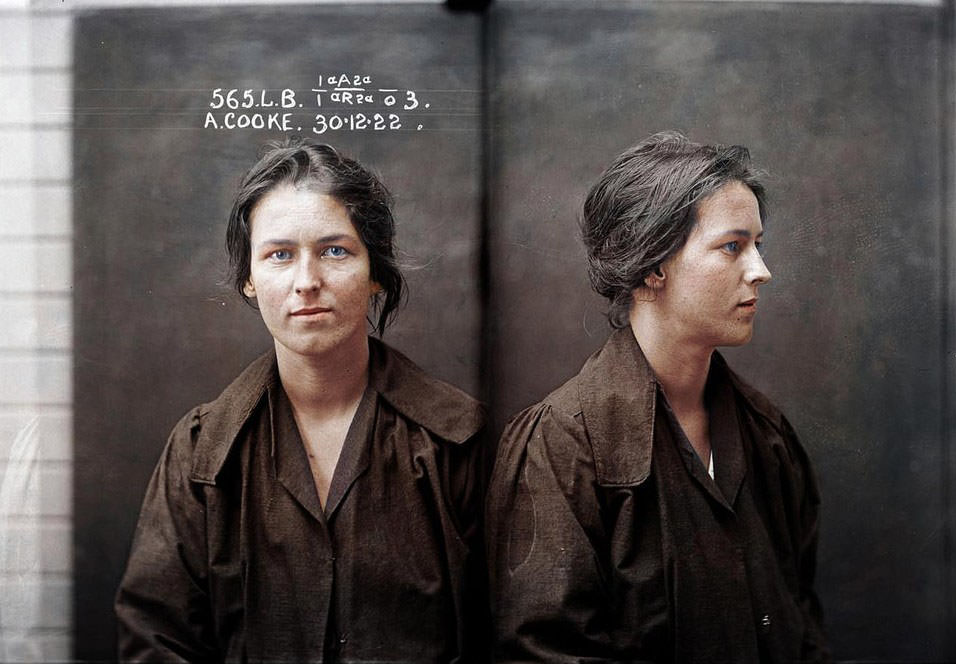
Alice Cooke’s prison intake portrait from the Sydney Women’s Reformatory in 1922 is presented here in a careful colorization that brings an archival record into sharper, more immediate focus. The composition follows the familiar two-view format used by institutions of the era: a forward-facing pose beside a profile view, set against plain boards and measured markings intended to standardize the body for the file. Above her head, the chalked identification text and numbers underscore how the system reduced a person to a catalog entry even as the camera fixed her likeness.
In the frontal view, Cooke meets the lens with a steady, unsmiling calm that reads as weary, guarded, and resolute all at once. Her dark hair is loosely arranged, and the heavy, utilitarian clothing—simple fabric, broad collar, practical cut—suggests regulation dress rather than personal choice. The profile image, turned toward the right, emphasizes the clinical purpose of the photograph, with the soft fall of light revealing texture in cloth and skin where the original monochrome would have flattened detail.
Seen today, this 1922 reformatory photograph invites reflection on early twentieth-century ideas about women, morality, and “reform,” as well as the bureaucratic routines that shaped life inside such institutions. Colorization does not change the document’s intent, but it can narrow the emotional distance, making the subject feel less like a relic and more like a real individual caught in a moment of enforced documentation. For readers interested in Australian social history, Sydney’s women’s institutions, and the visual language of police and prison records, the image stands as a stark, searchable window into a past that still echoes.