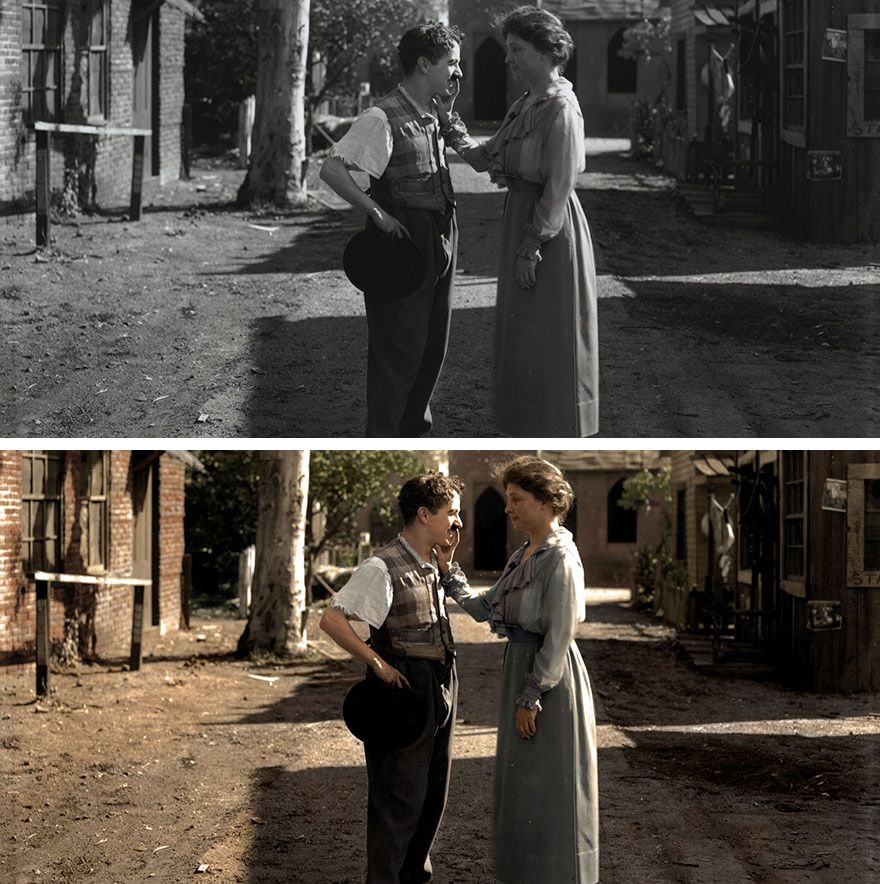
A quiet, intimate moment unfolds between Helen Keller and Charlie Chaplin, framed by a sunlit studio street of brick walls, shade trees, and dusty ground. Chaplin’s familiar silhouette—rumpled vest, loose trousers, and bowler hat held at his side—meets Keller at close range, the two turned toward one another as if the world has politely stepped back. In this encounter, their expressions and posture do most of the talking, making the scene feel both staged and deeply human.
Colorization brings an unexpected warmth to the setting: earth tones in the yard, soft light along the building facades, and the gentle contrast of clothing that reads as lived-in rather than theatrical. Keller’s hand rests against Chaplin’s face, a detail that draws the eye and hints at how communication and recognition could be shared beyond sight and sound. The effect is to pull a century-old photograph into the present without stripping away its period texture.
Beyond celebrity novelty, “Helen Keller meeting Charlie Chaplin in 1919” evokes a crossroads of early film culture and public advocacy, when icons carried enormous symbolic weight. Chaplin’s screen persona relied on pantomime and gesture, while Keller’s life story was widely known for its triumph over barriers—together they form a powerful reminder that meaning can be conveyed in many languages. For readers searching for a rare historical photo, a restored colorized image, or a glimpse of 1919-era film history, this post offers a small scene with an outsized legacy.