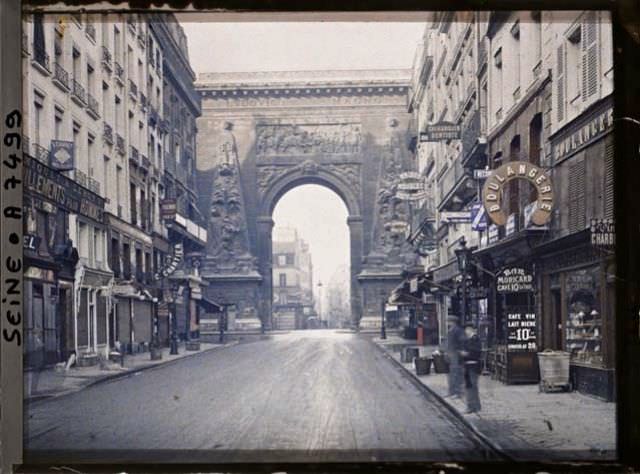
Rising at the end of a broad, nearly empty roadway, the Porte Saint-Denis anchors the scene like a stone proscenium, its sculpted reliefs and monumental arch pulling the eye straight down the street. On either side, tall façades form a tight urban corridor where shopfronts, awnings, and hanging signs press into the sidewalk, suggesting a neighborhood built as much for daily commerce as for grand ceremony. The colorization adds a gentle immediacy—muted tones on masonry and storefronts hint at textures that black-and-white often flattens, while still preserving the photograph’s early, glass-plate clarity.
Along the faubourg, small details do much of the storytelling: a “Boulangerie” sign curves over one entrance, other advertisements cluster at street level, and window displays face the road like a quiet invitation. Few pedestrians appear, and the street itself reads as freshly cleared, emphasizing scale—the arch seems even larger when the traffic of modern Paris is absent. The buildings’ repetitive shutters and stacked floors underscore how dense and vertical city life had become around this historic gateway.
Stéphane Passet’s view balances monument and everyday Paris, offering a street-level perspective that feels both documentary and theatrical. The Porte Saint-Denis, celebrated as a landmark, is framed not from a postcard distance but from within the working neighborhood that surrounds it, where commerce and architecture meet in a single vanishing line. For readers interested in early colorized photography, Parisian streetscapes, or the changing face of the faubourgs, this image provides a vivid entry point into the city’s past without needing a caption full of names and dates.