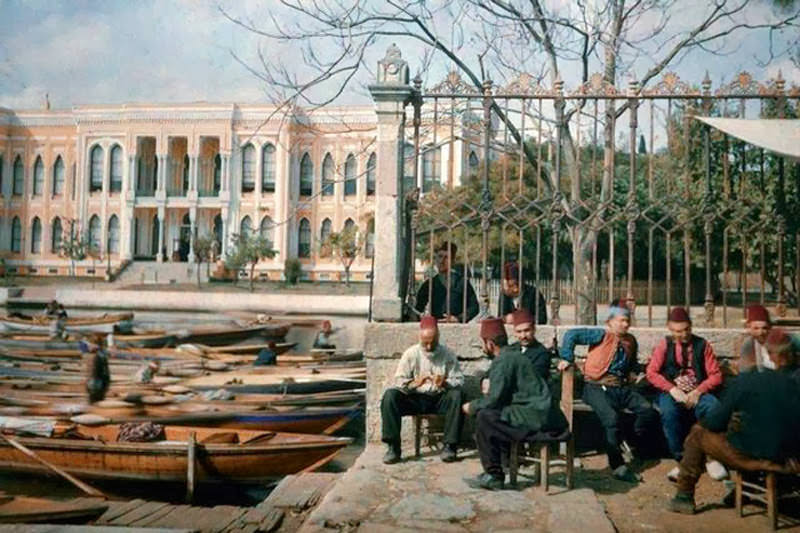
Along the waterfront of the Golden Horn, a small circle of men settles into the unhurried ritual of coffee, their stools pulled close on a stone quay beside a thicket of moored wooden boats. Fezzes and layered garments lend the scene an unmistakably Ottoman feel, while the colorization brings out warm reds and earth tones that might otherwise be lost to time. It’s an intimate glimpse of everyday sociability in Constantinople—today’s Istanbul—where conversation and caffeine could pause the day as surely as any call to work.
Behind the figures, an iron fence and winter-bare branches frame a long, elegant building with repeating arches and tall windows, suggesting an official or institutional presence near the water’s edge. The contrast is striking: formal architecture across the way, practical craft in the foreground, and people at the center binding both worlds together. Boats cluster like a floating marketplace, hinting at the Golden Horn’s role as a working harbor as much as a scenic inlet.
Coffee time here reads as more than refreshment; it feels like a shoreline checkpoint where news, bargains, and friendships could pass as readily as cargo. For readers searching for historic Istanbul, Ottoman-era street life, or colorized views of Constantinople, the photograph offers texture—work-worn timber, quiet posture, and the soft haze of a waterfront afternoon. Even without precise names or dates, the moment anchors the city’s long memory in something universally recognizable: the pull of a warm cup and good company by the water.