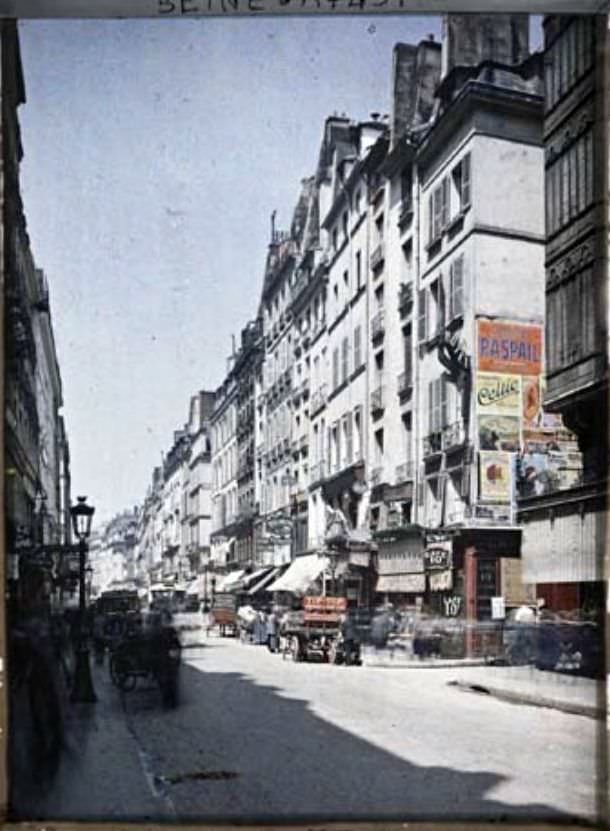
Rue Saint-Honoré opens out in a long, sunlit perspective at the corner of the Rue de la Sourdière, where tall Parisian façades stack windows and balconies above the bustle of the street. A row of shopfronts and awnings hugs the ground level, suggesting cafés and small businesses that catered to an always-moving crowd. The colorization brings extra immediacy to the scene, turning stone, sky, and signage into something closer to lived memory than distant record.
Along the curb, horse-drawn traffic and carts mingle with pedestrians, giving the intersection a working rhythm rather than a staged postcard calm. Posters and painted advertisements cling to the walls, hinting at popular products and the early power of street marketing in central Paris. Even without a precise timestamp in the caption, the mix of transport, storefront design, and public advertising evokes a city transitioning into modernity while keeping older routines close at hand.
Stéphane Passet’s view rewards lingering: the deep vanishing line down Rue Saint-Honoré, the alternating bands of shadow and light, and the layered textures of masonry and wood all guide the eye. For readers interested in Paris history, French streetscapes, and early color photography techniques, this corner scene offers a vivid reference point for how everyday life once looked on one of the capital’s best-known arteries. The result is both documentary and atmospheric—an urban moment preserved, then gently reawakened through color.