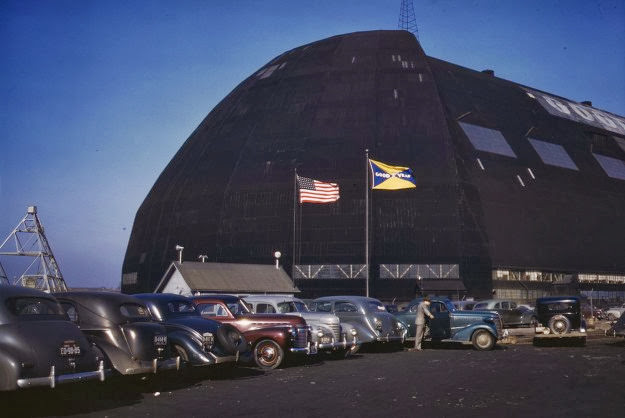
Rising like a dark hill against the sky, the former aircraft dock at Goodyear Aircraft Corp. dominates the Akron, Ohio, scene in 1941, its curved walls hinting at an earlier life built for immense airships and oversized engineering. Two flags—one the U.S. banner and the other bearing the Goodyear name—add movement and identity to the façade, while the colorized tones make the industrial scale feel immediate rather than distant. The building’s sheer bulk tells its own story about how American factories were designed to accommodate ambitions that kept growing.
Down at ground level, a line of neatly parked 1940s automobiles anchors the viewer in everyday reality, their rounded fenders and glossy paint contrasting with the hangar’s austere, utilitarian surface. A few figures stand near the cars, small in proportion to the structure behind them, emphasizing how this was a workplace defined by monumental spaces and coordinated labor. Even without seeing the machinery inside, the exterior suggests the hum of sub-assembly shops operating under one roof—parts moving, schedules tightening, and output measured in wings, fuselages, and fittings.
Industry in Akron is often associated with rubber, yet this image points to a broader wartime-era transformation, when specialized facilities were repurposed to meet the demands of aircraft production. The title’s reference to “aircraft sub-assembly shops” invites a closer look at how industrial architecture adapted: a building once meant for docking became a hive for making components that would later come together as finished aircraft elsewhere in the plant. For readers searching for Goodyear Aircraft history, World War II home-front manufacturing, or the famed Akron airship hangars, this photo offers a vivid entry point into the scale and urgency of 1941 American production.