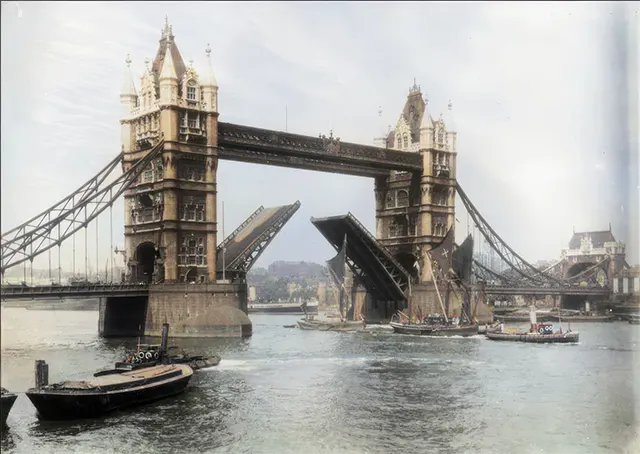
Rising above the River Thames, Tower Bridge appears here as both a landmark and a working machine, its twin Gothic Revival towers anchored firmly to the embankments. The colorization brings out warm stone tones, dark ironwork, and the lattice of suspension elements that guide the eye toward the high-level walkway. With the bascules lifted, the bridge’s famous split roadway becomes the star of the scene, revealing the engineering drama built into London’s daily routine.
On the water, small steam-powered craft and working boats drift and maneuver beneath the open span, emphasizing how closely river traffic and city life once depended on precise timing. The Thames looks busy but navigable, a corridor where commerce, labor, and travel met the constraints of tide and bridge schedule. Details along the shoreline and the hazy mass of buildings beyond hint at an industrial capital expanding outward, even as the bridge’s medieval styling nods to an older London.
Completed in 1894, Tower Bridge quickly became a symbol of Victorian ambition—part spectacle, part solution to a practical problem: keeping road connections intact while still allowing tall-masted vessels to pass upriver. Viewing the bascules raised makes the bridge’s purpose instantly legible, turning an iconic postcard view into a moment of motion and function. For readers searching for Tower Bridge history, River Thames photographs, or Victorian London engineering, this restored image offers a vivid window into how the city balanced tradition, technology, and the demands of a working port.