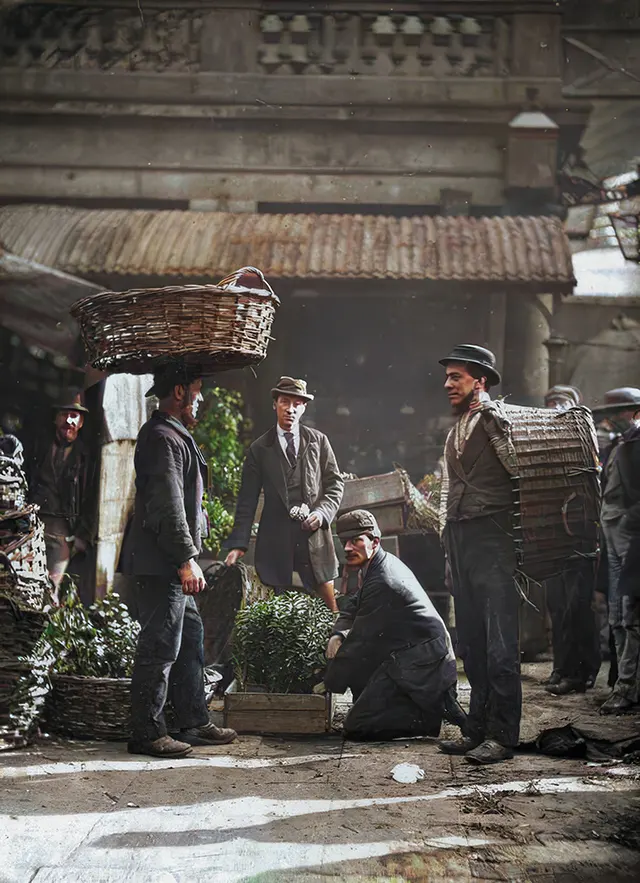
Under the worn awning and heavy stonework of Covent Garden, flower sellers pause amid baskets, crates, and heaps of greenery, their faces set with the focus of people who earn by the hour. The colorization brings out the earthy tones of jackets and caps, the pale dust of the ground, and the fresh, living scatter of leaves and blossoms that made this market famous. Wicker hampers—some carried high, some strapped to a back—hint at the constant movement between carts, stalls, and buyers just out of frame.
A small knot of laborers dominates the scene: one crouches close to a box of plants as if sorting stems, while others stand watchfully in conversation, shouldering the day’s weight in both senses. Their clothing is practical and worn, built for damp mornings and long shifts, and the crowded edges suggest a busy marketplace where space was always contested. Even without a written sign, the architecture and routine bustle evoke the trading heart of London’s flower commerce in the 1890s.
Colorized historical photos like this invite a different kind of attention, turning a distant century into something immediate—the texture of woven baskets, the sheen of a hat brim, the lush green that signals livelihood as much as beauty. For anyone searching for Victorian London, Covent Garden market history, or the working lives behind the city’s floral trade, this image offers a grounded glimpse of everyday labor. It’s not a posed portrait of prosperity, but a street-level view of commerce, endurance, and the quiet choreography of men selling flowers in one of Britain’s best-known markets.