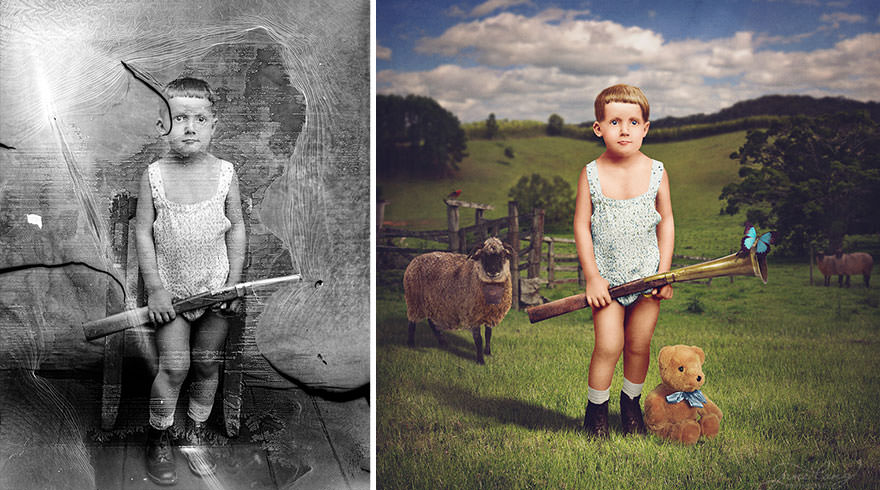
A small child stands stiffly for the camera, hands wrapped around a long gun that feels almost too heavy for the scene, while the original glass-plate negative bears the scars of time—scratches, blotches, and chemical wear that read like weather on old stone. That tension between innocence and gravity is part of what makes early portraiture so unsettlingly memorable, especially when the subject’s direct gaze refuses to soften. Even without a caption to pin down the where and when, the composition suggests a rural world where tools and weapons were familiar props, and where being photographed was an event worth holding still for.
On the colorized side, the photographer’s conceptual imagination transforms a stark studio-like void into an open countryside: rolling green fields, a big sky, and a quiet fence line. A sheep wanders close, and a teddy bear appears at the child’s feet—details that reframe the pose from mere severity into something more layered, mixing pastoral calm with staged symbolism. The child’s rosy skin tones, light hair, and patterned clothing pull the viewer closer, inviting modern eyes to read emotion and personality in ways black-and-white often keeps at a distance.
Recoloring historic glass-plate photos is never just about “adding color”; it is a form of interpretation that sits between restoration and storytelling. In this post, the before-and-after pairing highlights how pigment, background, and carefully introduced objects can change the narrative of an archival image while still honoring its documentary core. For anyone interested in photo history, vintage portrait photography, and modern colorization art, the result is a compelling reminder that the past can be both preserved and reimagined in the same frame.