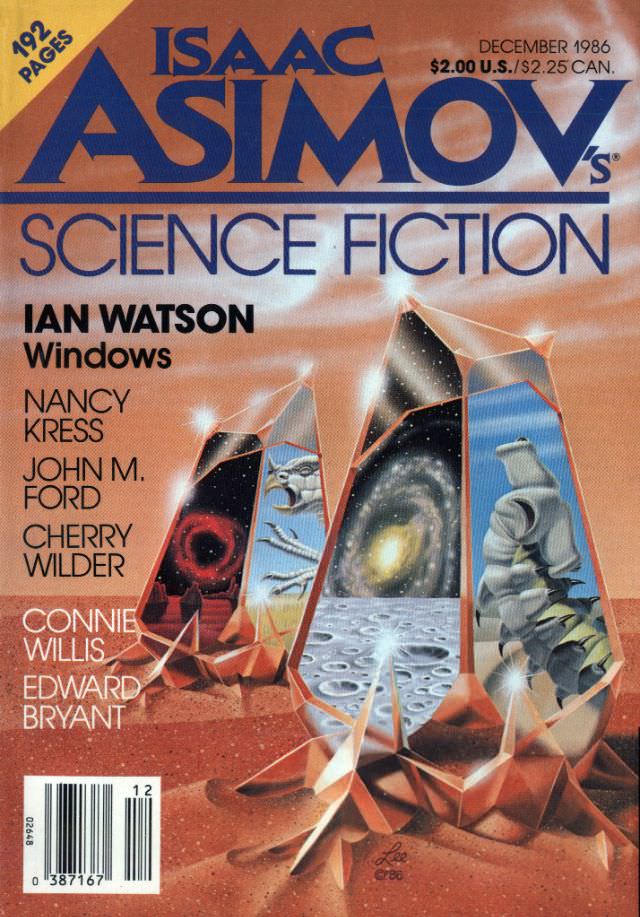
Bold typography and warm, coppery tones announce the December 1986 issue of *Isaac Asimov’s Science Fiction*, a moment when print magazines were still the primary gateway to new speculative worlds. The masthead dominates the upper half, with “Science Fiction” set beneath it and the cover’s practical details—“192 pages” and the $2.00 U.S./$2.25 Can. price—anchoring the design in its era. Even before a reader reaches the table of contents, the layout signals a confident, high-circulation publication aimed at devoted genre fans.
Across the lower half, the cover art builds a surreal landscape of faceted, mirror-like “windows” rising from a desert ground. Each shard reflects a different vista: a swirling galaxy, cratered lunar terrain, and a suited astronaut figure, all rendered with crisp highlights that make the panels feel like portals rather than simple reflections. The contrast between the arid foreground and the deep-space imagery sells the classic science fiction promise of stepping from the familiar into the cosmic unknown.
Prominent author lines—“Ian Watson” with “Windows,” alongside names like Nancy Kress, John M. Ford, Cherry Wilder, Connie Willis, and Edward Bryant—turn the artwork into an invitation to explore the issue’s fiction and ideas. For collectors and readers searching for Asimov’s magazine history, this December 1986 cover serves as a compact time capsule of late-1980s sci-fi aesthetics: glossy airbrushed illustration, angular futurism, and a curated roster of writers presented as the real attraction. It’s cover art designed not only to be noticed on a newsstand, but to linger in memory long after the stories are read.