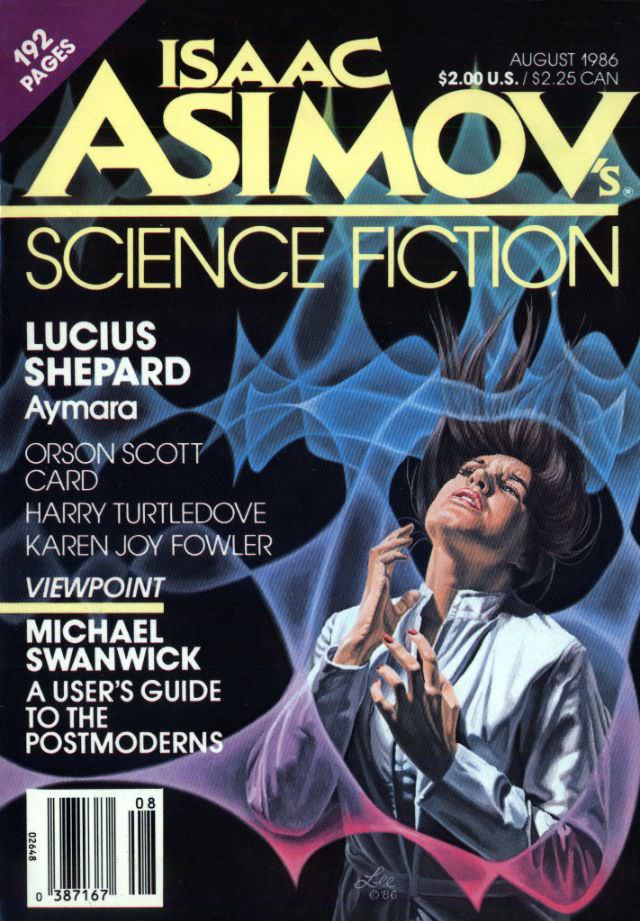
Bold typography dominates the August 1986 cover of Isaac Asimov’s Science Fiction, with the magazine’s title in large gold letters hovering over a dark, theatrical field. A banner calling out “192 pages” and the cover price immediately plants it in the tactile, newsstand era of print science fiction, when the design had to shout from a crowded rack. The overall layout balances prestige and punch, mixing clean, authoritative type with the promise of imaginative spectacle.
At the center, the cover art leans into surreal intensity: a figure in a pale shirt tilts back, eyes closed, hands raised as if caught between ecstasy and alarm, while ribbons of luminous blue and violet energy curl and billow around them. The smoky, wave-like forms suggest telepathy, possession, or a mind being tuned to an alien frequency—classic science fiction imagery rendered with a painterly, mid-1980s sheen. Against the black background, the glow reads like a visual metaphor for thought itself, made physical and dangerous.
Along the left side, the cover copy spotlights a lineup of recognizable genre voices, including Lucius Shepard’s “Aymara” and names such as Orson Scott Card, Harry Turtledove, and Karen Joy Fowler, anchoring the issue in the literary ecosystem of its time. A featured “Viewpoint” by Michael Swanwick, titled “A User’s Guide to the Postmoderns,” hints at the era’s debates over style, experimentation, and what science fiction was becoming. For collectors and readers browsing vintage magazine covers, this issue is a sharp snapshot of 1986: confident branding, vivid speculative art, and a table of contents that doubles as a map of the field.