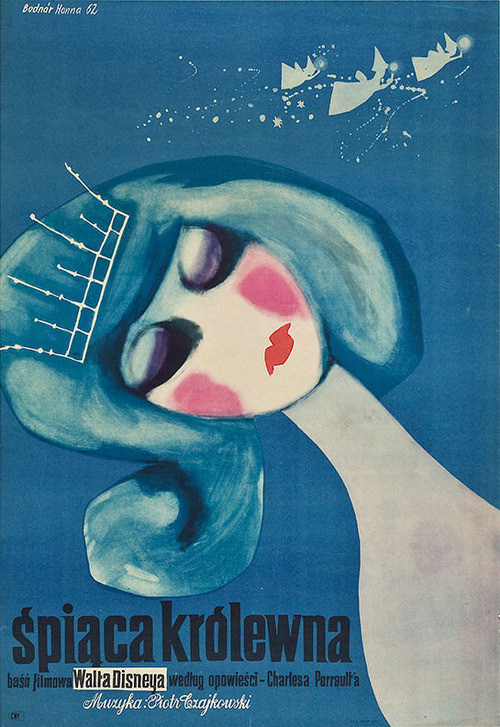
Drifting across a deep blue field, Hanna Bodnar’s 1962 cover art for “Sleeping Beauty” turns the familiar fairy tale into a modern dreamscape. A serene face fills the composition at an angle, framed by sweeping teal hair and closed, violet-shadowed eyes, while rosy cheeks and bright red lips add a theatrical, storybook hush. The minimal palette and bold, simplified forms signal mid-century graphic design at its most confident—less about realism, more about mood.
Above the sleeping figure, tiny crown-like shapes and starry specks trail like a spell in motion, suggesting enchantment without spelling it out. A delicate lattice motif near the hairline hints at a castle window or a fragment of a royal setting, reduced to a few crisp lines. The result is a poster-style illustration that feels both playful and slightly mysterious, capturing the suspended time at the heart of “Sleeping Beauty.”
Even the typography contributes to the period atmosphere, with the title rendered in strong, dark lettering beneath the image and smaller lines of Polish text anchoring it as printed cover art rather than a gallery canvas. For collectors of vintage poster art, Disney ephemera, or 1960s illustration, this piece offers an elegant example of how international design languages reinterpreted classic narratives. “Sleeping Beauty” by Hanna Bodnar remains strikingly memorable—an invitation to step quietly into a fairy tale told in color, silhouette, and sleep.