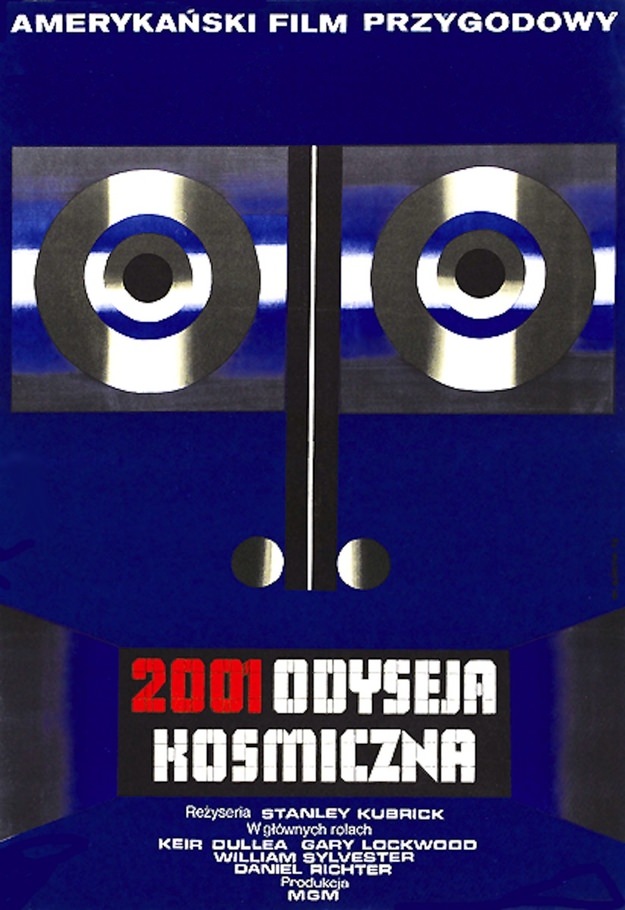
Bold Polish lettering crowns Wiktor Górka’s 1973 poster for “2001: A Space Odyssey,” immediately framing the film as an American adventure while speaking in the graphic language of Eastern European cinema advertising. A deep, saturated blue field dominates the composition, interrupted by hard, metallic circles and a stark vertical bar that reads like machinery, a corridor, or a sealed hatch. The design feels both clinical and uncanny, the kind of futuristic promise that also hints at something watching back.
Two large, lens-like forms anchor the upper half, suggesting eyes, camera apertures, or spacecraft ports—perfectly aligned, coldly symmetrical, and unsettling in their calm. Below, smaller circular details and the narrow central divide create a face-like illusion, turning abstract geometry into a presence that seems almost human. That ambiguity fits the story’s enduring tension between technology and consciousness, where sleek surfaces conceal motives we can’t fully interpret.
At the bottom, the title “2001 Odyseja Kosmiczna” is set in blocky, industrial type, with a punch of red that cuts through the blue like an alarm light. The credits—naming director Stanley Kubrick among the Polish text—root this artwork in its purpose as cover art and promotion, yet the minimalist symbolism makes it stand on its own as a piece of retro sci‑fi graphic design. For collectors of film posters, fans of Kubrick, and anyone drawn to 1970s illustration, Górka’s vision offers a striking portal into the era’s imagination of space.