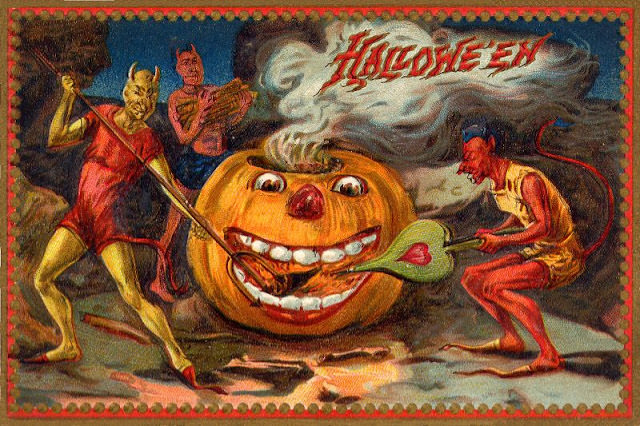
Across a scalloped red border, the word “Hallowe’en” curls through a plume of smoke, setting the tone like a carnival banner over a midnight stage. At the center grins an oversized jack-o’-lantern with wide, cartoon eyes and a mouthful of big teeth, half mischievous and half menacing. The saturated colors and exaggerated expressions mark this as cover art designed to grab attention instantly—equal parts humor, fright, and spectacle.
Devilish figures crowd the scene, their horns and pointed tails turning folklore into playful theater. One red-clad imp advances with a raised club while another lurks behind, and on the right a crouching devil aims a pitchfork toward the pumpkin’s cheeky face. The composition is busy in the best way, with smoky atmosphere, sharp gestures, and a sense of movement that mirrors the unruly energy people associate with Halloween night.
As a piece of Halloween ephemera, this illustration reflects how popular art often blended macabre symbols with slapstick charm, making “spooky” feel more like an invitation than a warning. It’s an eye-catching historical image for anyone interested in Halloween cover art, vintage seasonal graphics, or the evolution of jack-o’-lantern imagery in print culture. Whether you read it as folk-horror lite or festive mischief, it shows how Halloween has long thrived on the delightful tension between fear and fun.