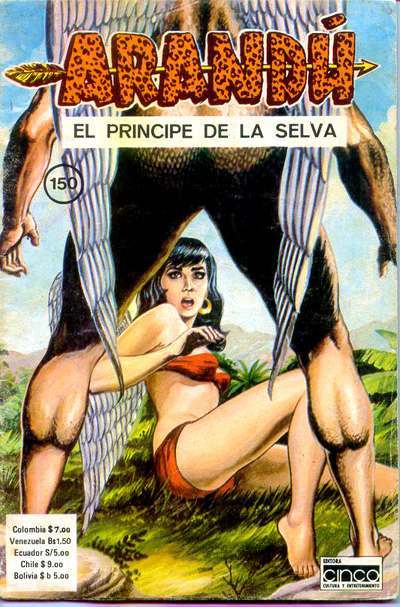
A bold Spanish-language cover shouts “ARANDÚ” with the subtitle “EL PRÍNCIPE DE LA SELVA,” pairing pulp adventure energy with a stage-like composition that instantly draws the eye. Dominating the foreground, a looming figure plants their legs wide in a rigid, triangular stance while the scene beneath them—lush greens, dramatic gestures, and a startled central character—plays out like a spotlighted tableau. Even the pricing block (“Colombia,” “Venezuela,” “Ecuador,” “Chile,” “Bolivia”) and publisher mark anchor it as mass-market cover art designed to grab attention at a glance.
That wide-legged “A-frame” posture is more than a bit of bravado; it’s a visual tool that creates a frame, a barrier, and a point of view all at once. By turning the body into an architectural shape, the artist forces perspective and hierarchy—power above, vulnerability below—while guiding the viewer’s gaze straight to the drama at the center. The result is a memorable silhouette that reads instantly, whether you’re seeing it on a crowded newsstand or in a fast scroll online.
From fashion editorials to movie posters, the same triangular stance keeps resurfacing because it telegraphs dominance, confidence, and spectacle with minimal explanation. Designers and photographers borrow it to exaggerate long lines and strong angles; poster artists use it to build a doorway into the story, literally framing a protagonist or peril between two bold strokes. In this post, the cover becomes a time capsule of how a single iconic pose can outlive its original context and keep shaping modern visual culture.