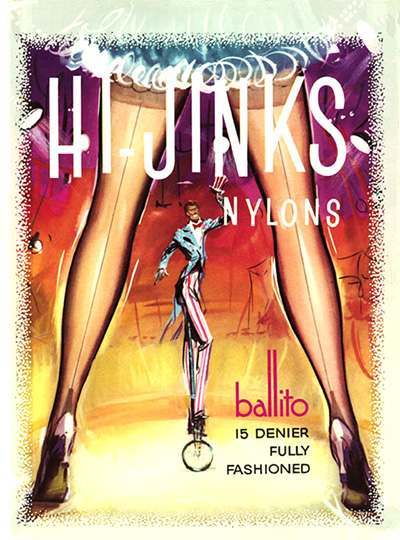
Between two towering, stylized legs, a slender performer balances on a unicycle and lifts an arm in a crisp, angular salute—an “A-frame” arrangement that instantly pulls the eye upward. The composition feels like a stage: curtains of color, dramatic scale shifts, and a single figure posed to turn geometry into glamour. Bold lettering for “HI-JINKS NYLONS” and “ballito 15 denier fully fashioned” anchors the scene in the world of hosiery advertising, where illustration sold not just a product but an attitude.
What makes this cover art endure is its command of negative space and its playful use of perspective, turning the body into architecture and the pose into a logo. The performer’s raised arm and elongated silhouette echo the triangular stability that fashion photography and poster design still rely on when they want instant readability from a distance. Even without a specific date or place printed on the artwork, the styling signals an era when fully fashioned stockings, theatrical sophistication, and graphic bravado were central to visual culture.
Modern fashion editorials, art prints, and movie posters keep borrowing these same tricks: framing a subject with oversized foreground elements, exaggerating limbs into design lines, and using a single, confident gesture to telegraph character. Here, the A-frame isn’t just a pose—it’s a compositional engine that creates drama, hierarchy, and movement in one glance. For anyone tracing the history of advertising illustration and its long shadow over contemporary design, this image is a vivid reminder that good geometry never goes out of style.