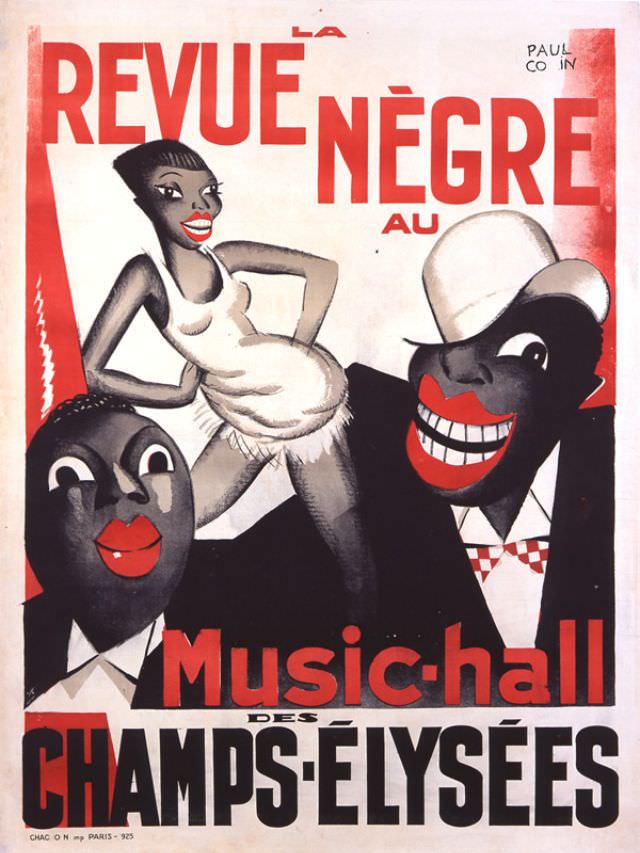
Bold typography and a limited palette of red, black, and white give this 1924 “Revue Nègre” cover art the punch of a street poster meant to stop passersby in their tracks. The lettering dominates the upper half, while the lower text anchors the advertisement with “Music-hall des Champs-Élysées,” positioning the design squarely in the world of Paris entertainment and early 20th-century nightlife. As graphic design, it leans into high contrast and theatrical exaggeration, the kind of visual shorthand that promised energy, rhythm, and spectacle.
At the center, a dancer strikes a confident pose, framed by two grinning figures rendered in caricature, their faces and lips stylized to an unsettling extreme. That visual choice speaks to the period’s commercial appetite for “exotic” performance while also revealing how Blackness was frequently filtered through stereotypes in European popular culture. The result is a complicated artifact: simultaneously a vivid piece of Art Deco-era advertising and a reminder of the racist imagery that circulated openly in mainstream venues.
For historians, collectors, and anyone researching Revue Nègre, Paris music-hall history, or 1920s poster art, this cover offers more than decoration—it shows how modern entertainment was packaged and sold. The dynamic composition and showy lettering make it useful for discussions of theatre promotion, printing aesthetics, and the visual language of the Jazz Age. Viewed today, it invites a careful reading that holds both truths at once: the era’s innovative design flair and the harmful stereotypes embedded in its popular imagery.