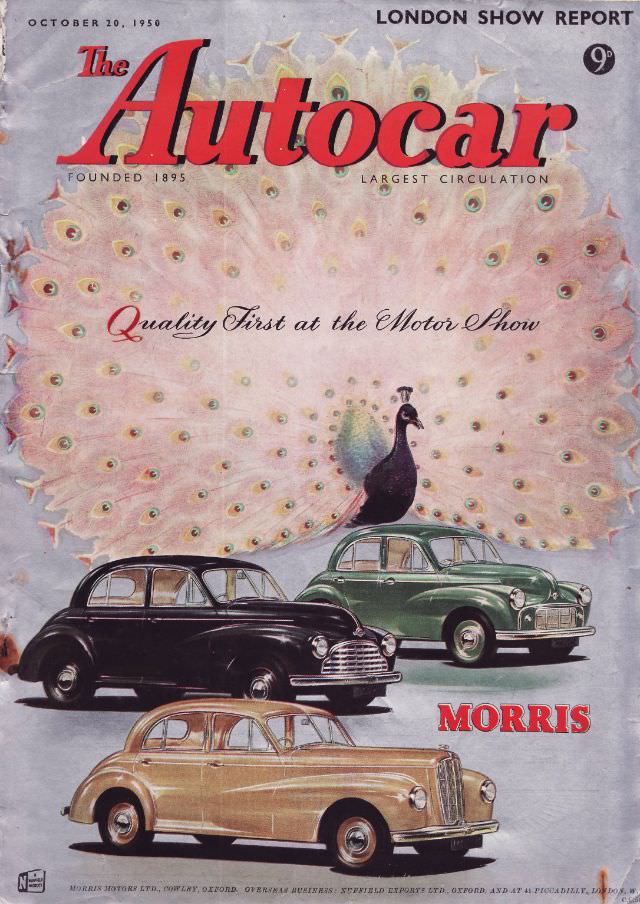
October 20, 1950 arrives in bold, sweeping type across the cover of The Autocar, billed as a “London Show Report” and priced at 9d. The magazine’s masthead sits over a soft, painterly background that immediately signals post-war optimism—an era when motoring journalism sold not just specifications, but aspiration, style, and national confidence in engineering.
A peacock fans its tail like a living burst of chrome and enamel, perched above three neatly rendered Morris saloons. The slogan “Quality First at the Motor Show” ties the flourish to its purpose: this is advertising art designed to make reliability feel glamorous, turning showroom polish into a visual metaphor for pride and craftsmanship. Even without diving into model names, the silhouettes—rounded bodies, bright trim, and upright cabins—place the cars firmly in mid-century British design.
Details around the edges reinforce the publication’s authority, including “Founded 1895” and a nod to “Largest Circulation,” while the word “MORRIS” anchors the composition as the featured marque. For collectors of automotive ephemera, magazine cover art, or London Motor Show history, this issue offers a vivid snapshot of how 1950s car culture was packaged: confident typography, elegant illustration, and a promise that modern motoring could be both practical and proudly stylish.