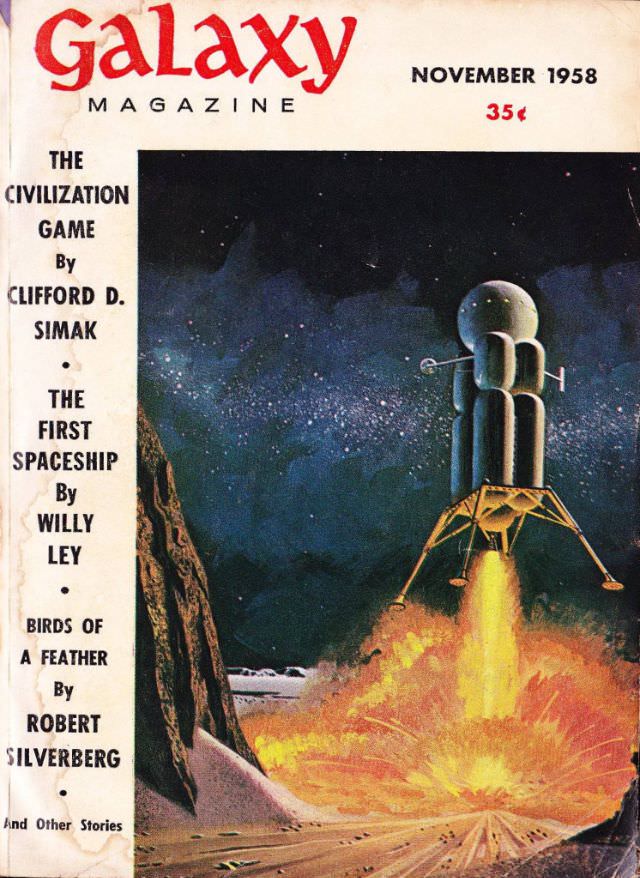
Galaxy Magazine’s November 1958 cover throws you straight into the Space Age imagination, with bold red masthead lettering and a crisp “35¢” price tag anchoring the era. The layout balances clean, magazine-stand typography on the left with a dramatic painted scene on the right, the kind of design meant to stop browsers in their tracks. Even the simple “NOVEMBER 1958” at the top feels like a time-stamp from the early days of modern science fiction publishing.
At the heart of the cover art, a squat, futuristic lander hovers above a cratered surface, its engine plume blasting up dust and fire as it descends. The starfield behind it is dense and dreamy, suggesting deep space rather than a familiar sky, while the rocky foreground adds scale and danger. That contrast—cold cosmos, hot exhaust, sharp shadows—captures the classic mid-century sci-fi mood: technological confidence wrapped in uncertainty and awe.
Down the left margin, the issue’s promised adventures are spelled out in stacked titles and author credits, including “The Civilization Game” by Clifford D. Simak, “The First Spaceship” by Willy Ley, and “Birds of a Feather” by Robert Silverberg. Together with the landing scene, the text sells a blend of speculative storytelling and spacefaring fascination that defined Galaxy Science Fiction for many readers. As a piece of vintage magazine cover art, it’s both an eye-catching collectible and a window into how 1950s science fiction pictured the future.