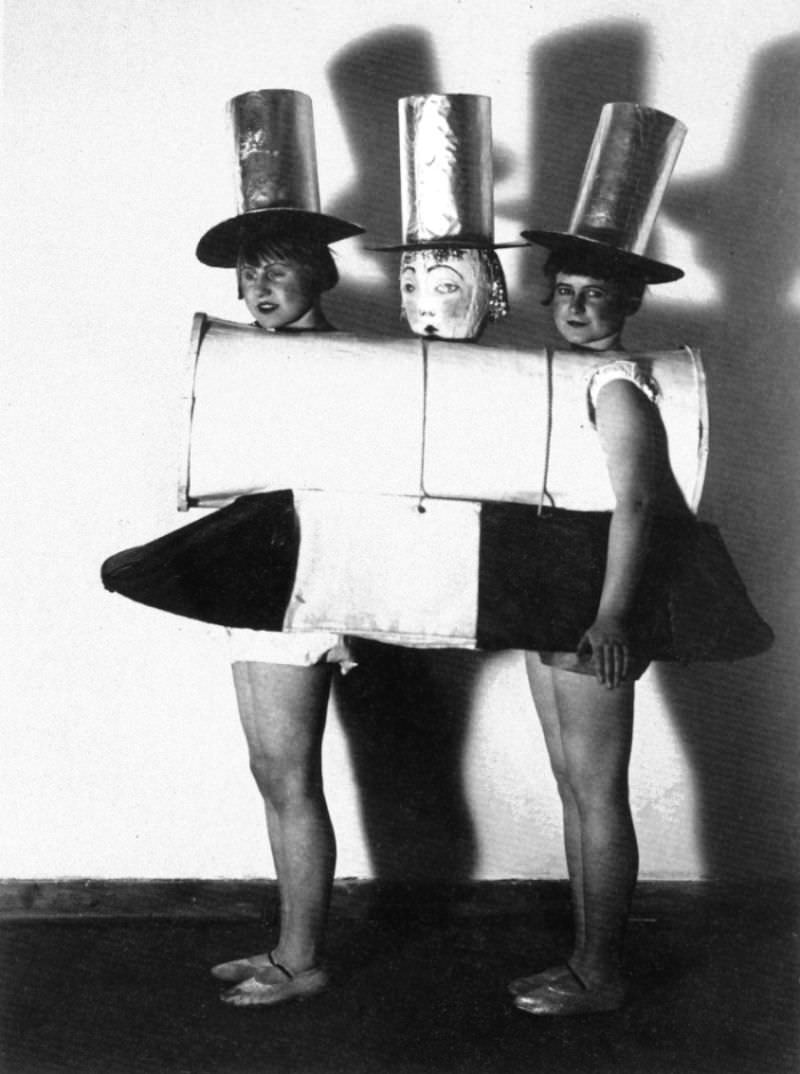
Three performers stand shoulder-to-shoulder, their bodies transformed into a single, witty construction of cylinders and blocks that reads like wearable architecture. Tall, glossy top hats rise above bobbed hair and stage makeup, while a broad geometric costume wraps across all three figures, turning individual dancers into a coordinated, machine-like chorus. Bare legs and simple footwear peek out beneath the rigid forms, underscoring the playful tension between human movement and sculptural restraint.
At the center, a painted, mask-like face stares forward, flanked by two smiling companions whose expressions hint at backstage mischief as much as avant-garde theater. Strong lighting throws dramatic shadows onto the plain wall behind them, doubling the silhouettes and emphasizing the sharp outlines of the costume’s curved tubes and flat planes. The overall effect feels both comic and uncanny—part cabaret spectacle, part modernist experiment—capturing the era’s fascination with abstraction, design, and the stage as a laboratory.
Linked to the Triadic Ballet and the broader Roaring Twenties appetite for radical fashion and performance, the photograph embodies a moment when geometry became a new kind of glamour. Here, clothing is no longer merely decorative; it dictates posture, spacing, and rhythm, turning dancers into living diagrams that suggest speed, industry, and the future. For anyone searching the history of avant-garde dance, Bauhaus-inspired costume, or surreal 1920s culture, this image offers an unforgettable snapshot of modernism made theatrical.