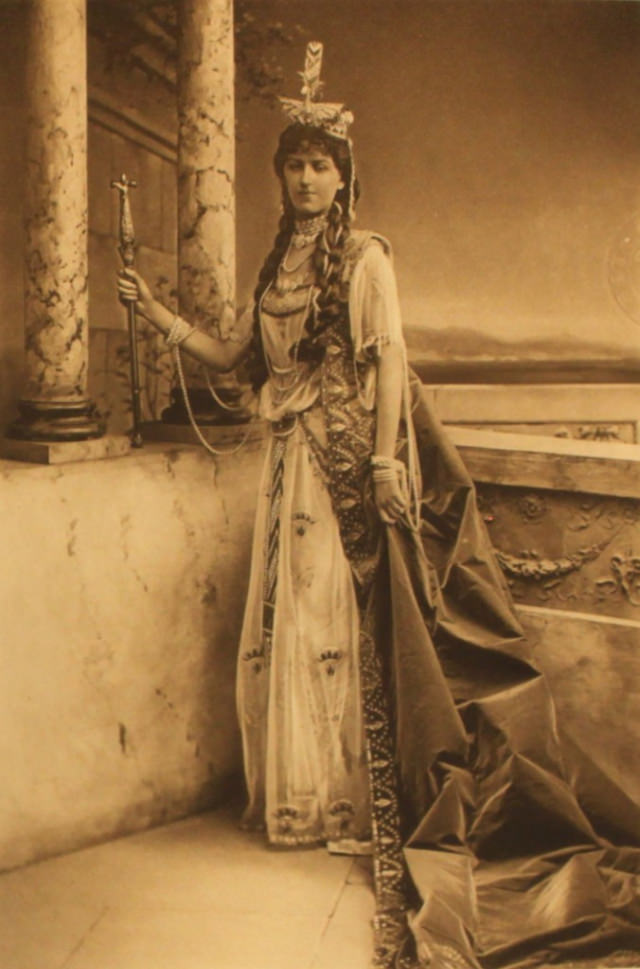
Poised beside a painted terrace and marble-like columns, Lady de Trafford appears in character as Semiramis, the legendary Queen of Assyria, her stance both theatrical and self-assured. A tall feathered or leaf-like ornament rises from her headdress, while long, dark tresses fall in heavy waves that frame her face and emphasize the deliberate antiquarian styling. In one hand she holds a slender staff or sceptre, an unmistakable emblem of authority that completes the royal pose.
The costume layers light, flowing fabric with richly patterned bands, suggesting an imagined Near Eastern splendour as filtered through late-Victorian taste. A jeweled collar and bracelets catch the light against the soft drape of the gown, and the train spills dramatically across the floor, turning the studio-like setting into a stage. Even the backdrop—open sky and distant horizon—adds to the illusion of empire, inviting the viewer to read the portrait as pageantry rather than everyday life.
Such portraits speak to the fascination with history, archaeology, and exoticized antiquity that shaped elite masquerades and fancy-dress culture in the late nineteenth century, including celebrated society costume balls. Semiramis, half-myth and half-monarch in popular imagination, offered a role that blended feminine glamour with the language of power, making her a compelling choice for a grand event. For readers interested in Victorian fashion, costume history, and the visual culture of high society, this image preserves the careful craftsmanship and storytelling that turned an evening’s entertainment into enduring historical imagery.