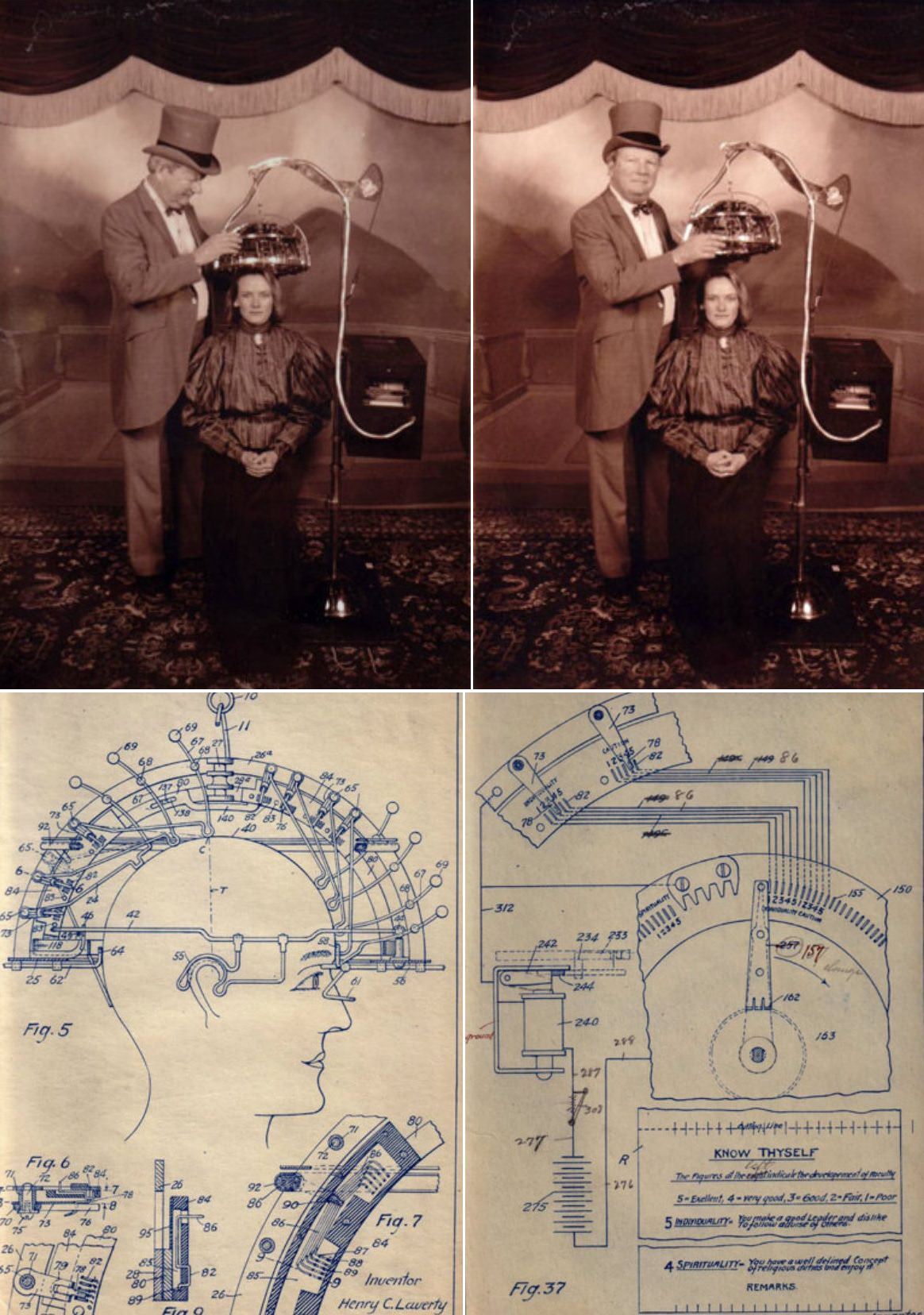
Under a draped stage canopy, a seated woman waits calmly while a man in formal attire steadies a dome-like apparatus above her head, its wires and fittings suggesting a blend of laboratory gear and theatrical prop. The scene has the feel of a public demonstration—part science lecture, part parlor spectacle—where invention promised to make the invisible workings of the mind visible, measurable, and neatly organized.
“The Psychograph” points to that long fascination with instruments that could read personality like a dial or chart, turning character into data. The device’s crown-like frame and the poised stance of the operator invite questions about authority and belief: who interprets the results, what counts as proof, and why audiences were eager to trust a machine to reveal private truths.
Below, patent-style drawings reinforce the idea that this was more than showmanship, mapping a head in profile with numbered contact points and a gauge panel marked “Know Thyself.” For readers interested in early inventions, psychology history, and the culture of self-improvement, this photo offers a vivid entry into an era when optimism about technology collided with enduring anxieties about identity, intelligence, and the promise of scientific certainty.