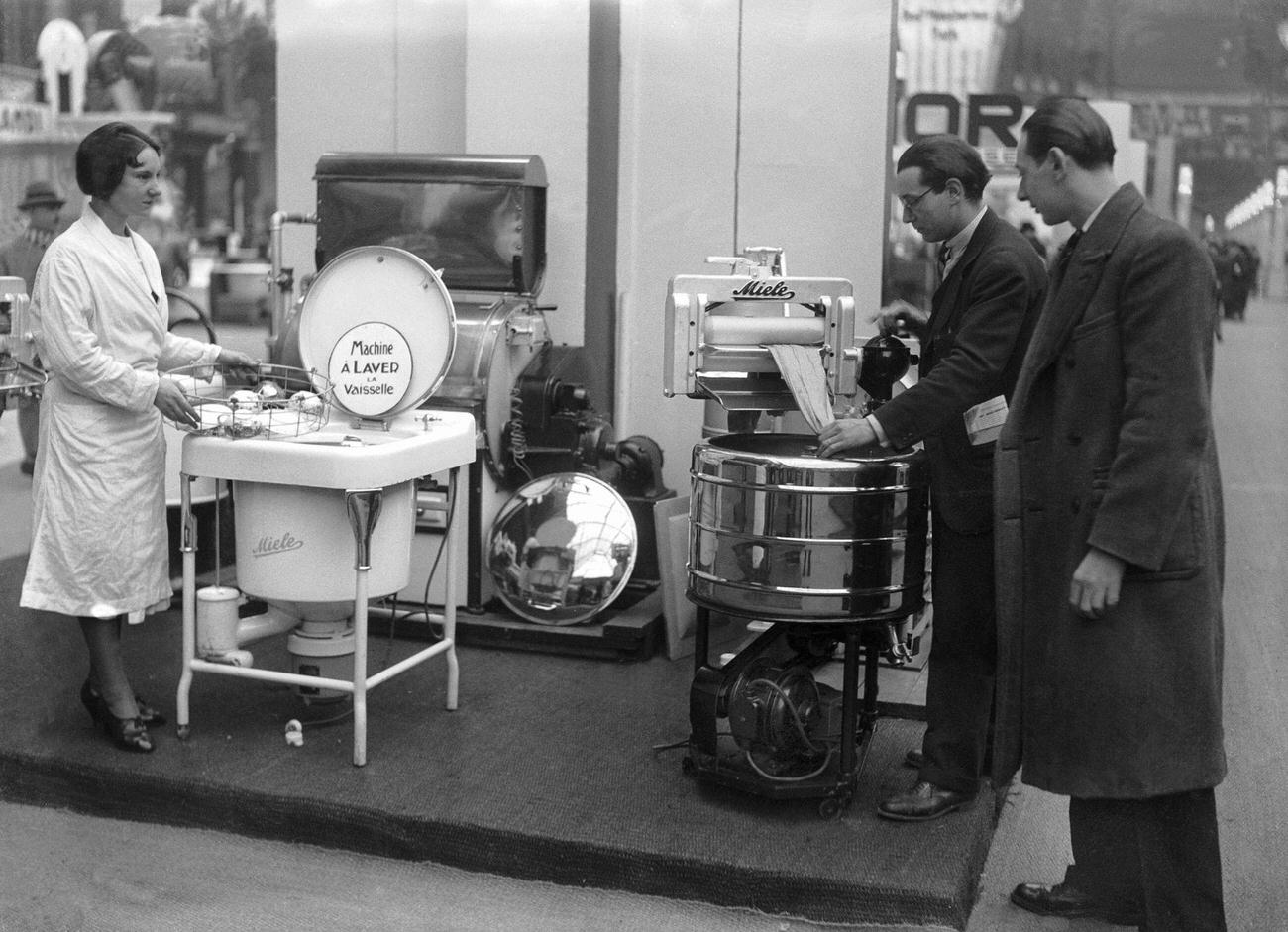
Paris in 1950 becomes a showroom for modern domestic ambition, with Miele presenting a dish washer prototype beside a washing machine in live demonstration. A woman in a work coat stands at the display, while two suited observers lean in toward the polished drum and exposed mechanisms. The French sign “Machine à laver vaisselle” reads like a promise of time saved, translating engineering into everyday convenience for anyone strolling past the stand.
What makes the scene compelling is the blend of spectacle and practicality: gleaming metal, open housings, and visible motors invite the viewer to trust the machinery rather than fear it. The arrangement feels halfway between laboratory and department store, where prototypes are not hidden but performed. Even the visitors’ posture suggests curiosity mixed with evaluation, as if deciding whether this new kind of household technology is truly ready for the home.
For historians of inventions and mid-century consumer culture, this photograph offers a crisp snapshot of the postwar pivot toward mechanized living. Miele’s early dishwasher concept and washing machine display hint at the coming transformation of kitchens and laundry rooms across Europe, driven by trade fairs, demonstrations, and word-of-mouth excitement. As an SEO-friendly window into 1950s appliances, it speaks to the origins of modern dishwashers, the evolution of washing machines, and the marketing of innovation in Paris, France.