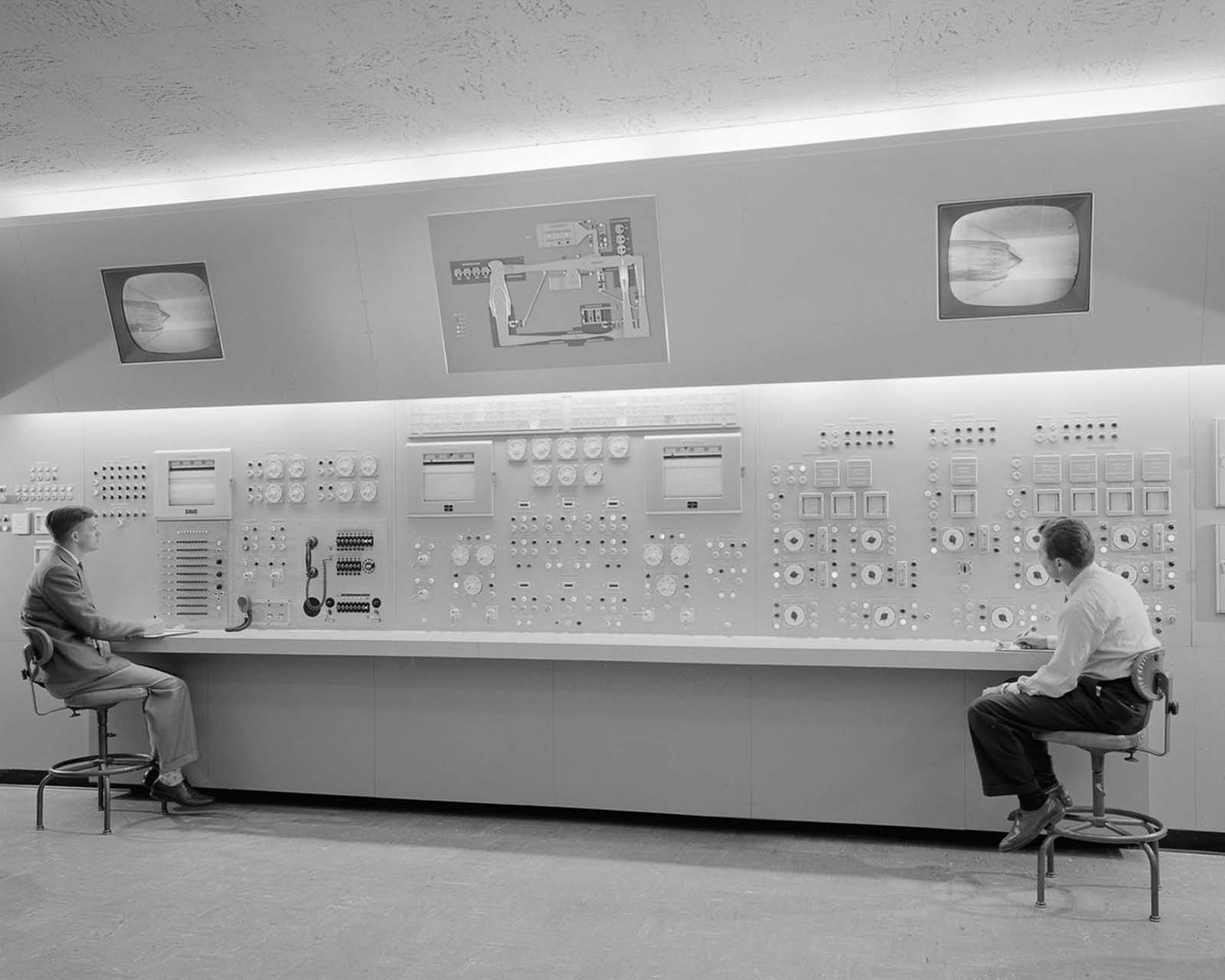
Stretching across the control room wall, one of three control panels for the Lewis Unitary Plan Wind Tunnel (1955) reads like a map of mid‑century engineering ambition. A dense grid of analog gauges, indicator lights, dials, and switches covers the board from end to end, with inset displays above that hint at live monitoring of airflow and test conditions. The long counter and seated operators emphasize how much of “automation” in this era still depended on focused human attention.
From their stools at opposite ends, two technicians face an instrument landscape designed for precision and redundancy, where every needle position mattered. Patch points, rotary selectors, and grouped meters suggest separate subsystems—power, pressure, temperature, and control—managed in coordinated sequence rather than by a single button press. Even the wall-mounted telephone speaks to a workflow built around communication and immediate response during demanding wind-tunnel runs.
For readers interested in inventions and aerospace research history, this historical photo offers a vivid look at the pre-digital control room: a place where data arrived as moving needles and luminous dots instead of streaming graphs. The Lewis Unitary Plan Wind Tunnel control panels helped translate experimental aerodynamics into reliable numbers, shaping how engineers evaluated models and refined designs. It’s a reminder that the sleek achievements of flight were often born in rooms like this—quiet, methodical, and lined with instruments.