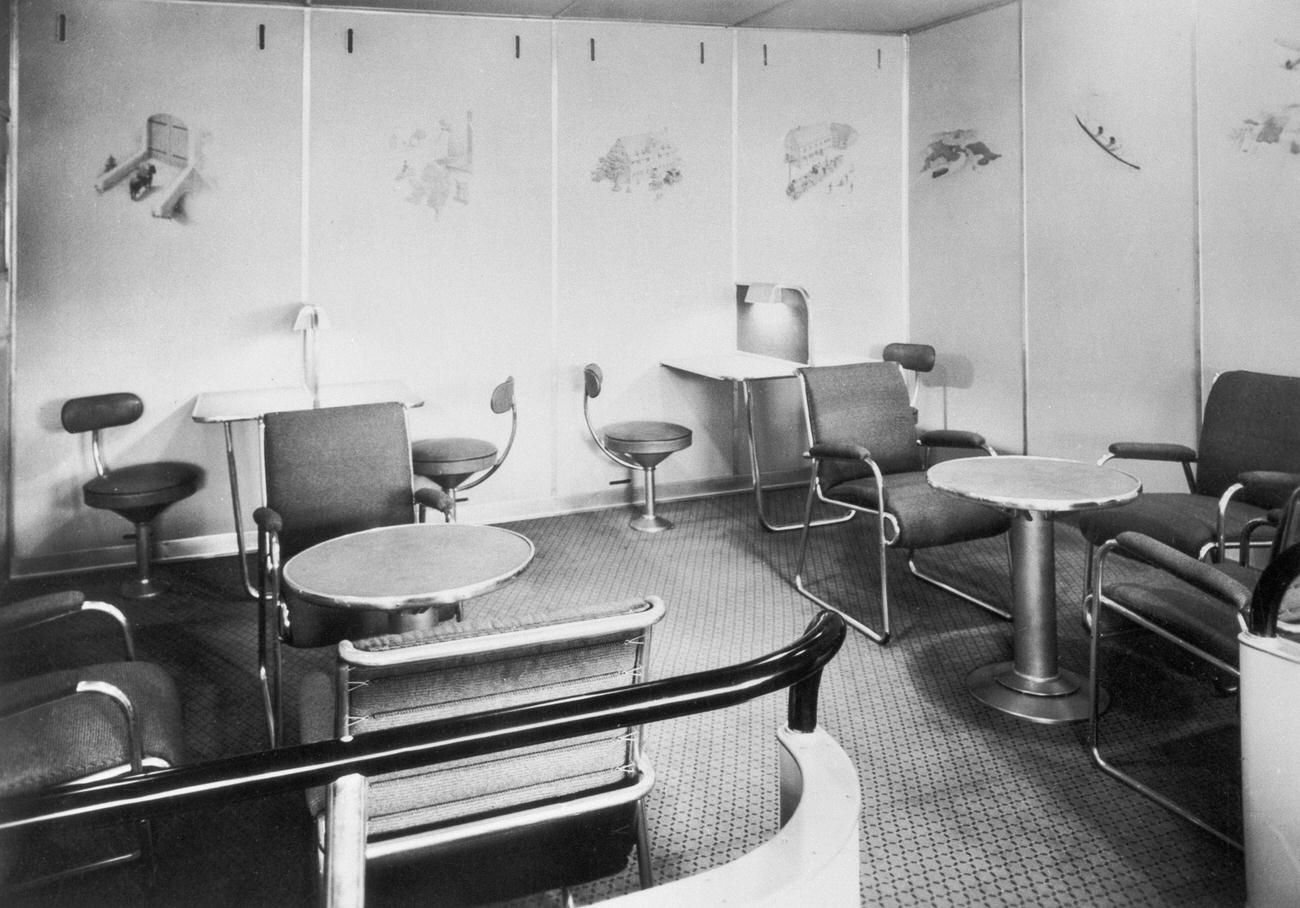
Quietly modern in its lines and furnishings, the reading and writing room aboard the Hindenburg feels more like a stylish lounge than a compartment in an airship. Low tables anchor clusters of upholstered chairs, while slim, built-in desks and small lamps suggest a space designed for letters, notes, and unhurried conversation. The patterned carpet and curved railing in the foreground add to the sense of careful planning, turning travel into something deliberately comfortable.
Along the wall, softly rendered illustrations—scenes of buildings and landscapes—lighten the room without cluttering it, echoing the era’s taste for streamlined decoration. Everything appears arranged for ease: chairs set at sociable angles, work surfaces tucked neatly against the paneling, and lighting placed where a page would naturally fall. As a piece of interior design history, it hints at the technological confidence of the time, when long-distance flight promised not only speed but a kind of floating civility.
For readers searching the story behind the Hindenburg, this photo offers a revealing look at daily life in a famous zeppelin beyond the headlines. It speaks to “inventions” in a quieter register—how engineering achievements were paired with human comforts, and how the culture of travel adapted to the sky. The room’s calm order invites the imagination: the scratch of pen on paper, the turn of a page, and the steady hum of an airship carrying its passengers between worlds.