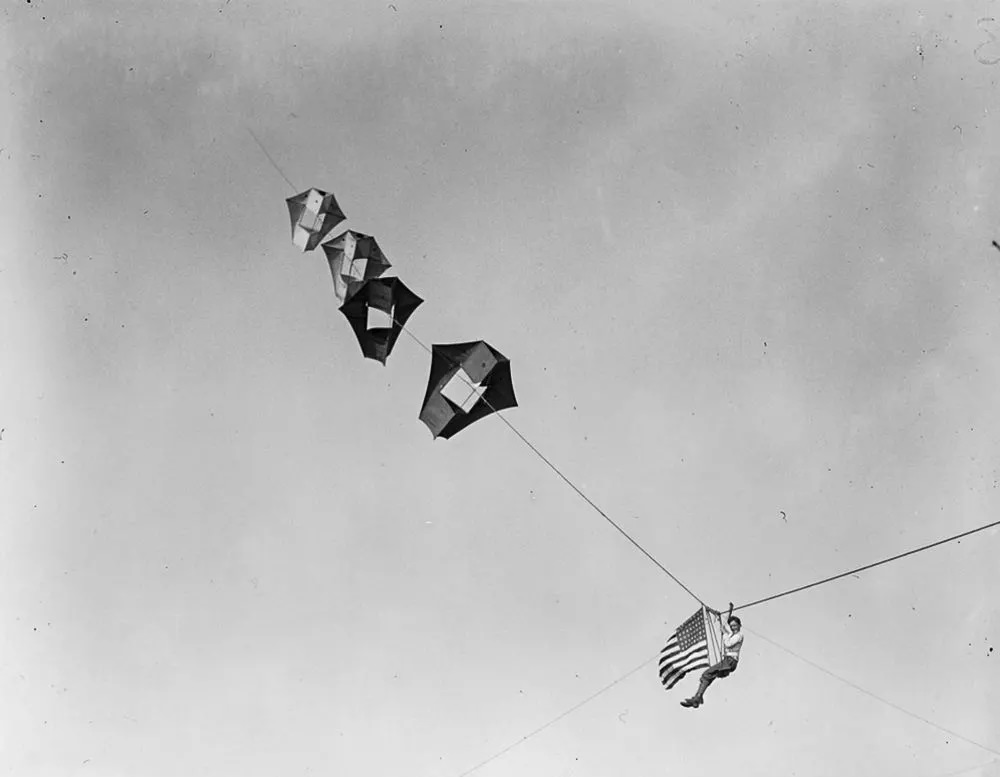
High above an empty sweep of sky, a train of boxy kites tugs steadily on a line, and—astonishingly—a person hangs beneath it like a living payload, legs dangling in midair. The composition is stark and theatrical: nothing but wind, rope, fabric, and nerve, with an American flag fluttering as a bold signal against the pale background. It’s the kind of scene that instantly reframes “kite flying” as serious engineering rather than a pastime.
Man-lifting kites were one of the more daring inventions to bridge the gap between balloons and airplanes, built to turn wind into altitude without an engine. By linking multiple kites together, designers could multiply lift and stabilize the pull, creating a temporary aerial platform for observation. Long before drones and lightweight aircraft became commonplace, this was a practical—if precarious—approach to reconnaissance technology, training, and experiment, using readily available materials and a deep understanding of airflow.
What makes this historical photo so compelling is how it captures a moment when innovation looked like improvisation, and risk was part of the research. The taut lines, the clustered kites, and the suspended human figure tell a story about early aerial reconnaissance methods and the inventive spirit of the era’s tinkerers and military planners. For readers exploring the incredible history of man-lifting kites, this image offers a clear reminder that the path to modern flight was crowded with ingenious, wind-powered detours.