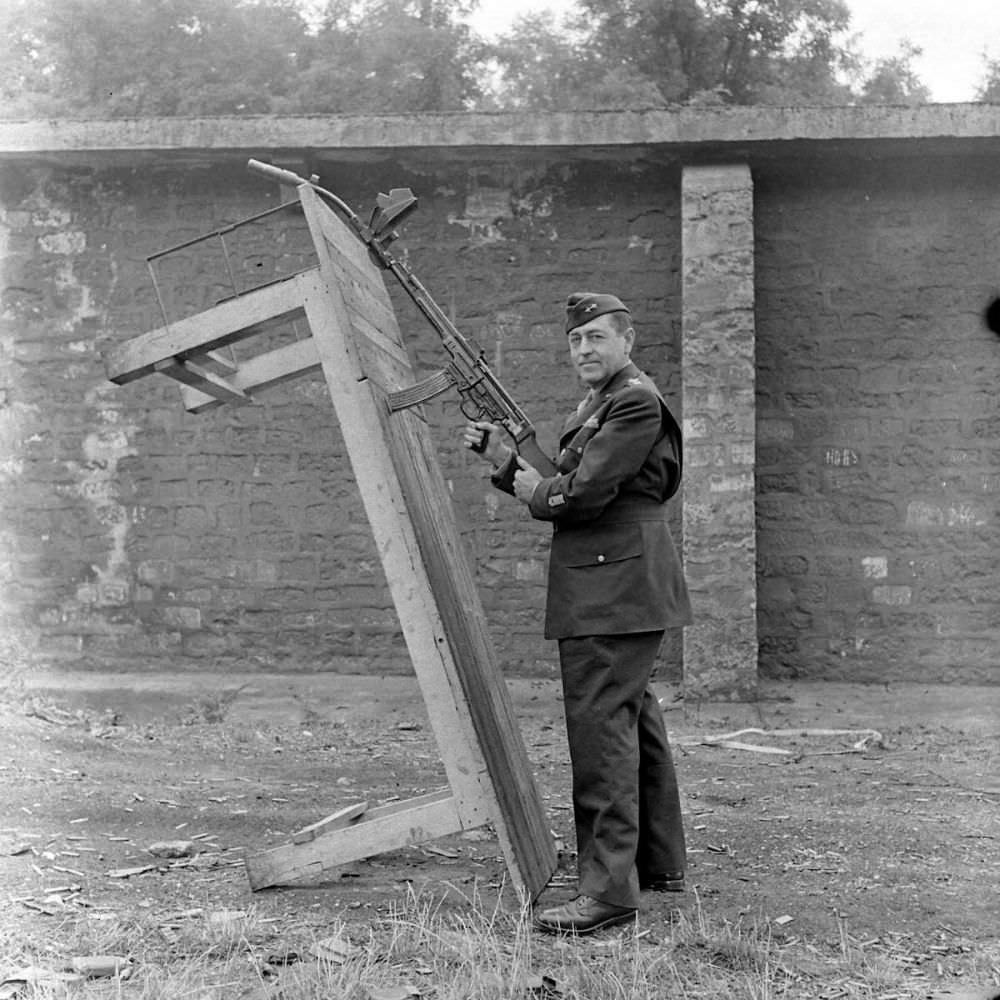
A uniformed tester stands beside a rough wooden frame, gripping a rifle-like weapon fitted with an unusual curved attachment at the muzzle—an improvised-looking device that instantly raises the question: can a bullet be made to turn a corner? The stark yard setting, scattered debris underfoot, and the plain brick wall behind him make the contraption feel less like science fiction and more like a field experiment carried out under wartime pressure.
The title points to the Krummlauf, a notorious WWII-era weapons invention associated with attempts to curve shots for firing from cover, around obstacles, or from within cramped spaces. In the photo, the angled mounting suggests controlled testing rather than combat use, hinting at the practical problem engineers were trying to solve: how to keep a shooter safer while still projecting fire into places a straight barrel can’t easily reach.
Readers drawn to WWII technology, experimental firearms, and strange military prototypes will find this post a revealing window into the era’s frantic innovation. The Krummlauf story sits at the intersection of engineering ambition and battlefield reality—where clever ideas met brutal physics, wear, and reliability limits. Look closely and the scene becomes a small lesson in how wartime inventions were tried, judged, and often discarded, even when they seemed astonishing on paper.