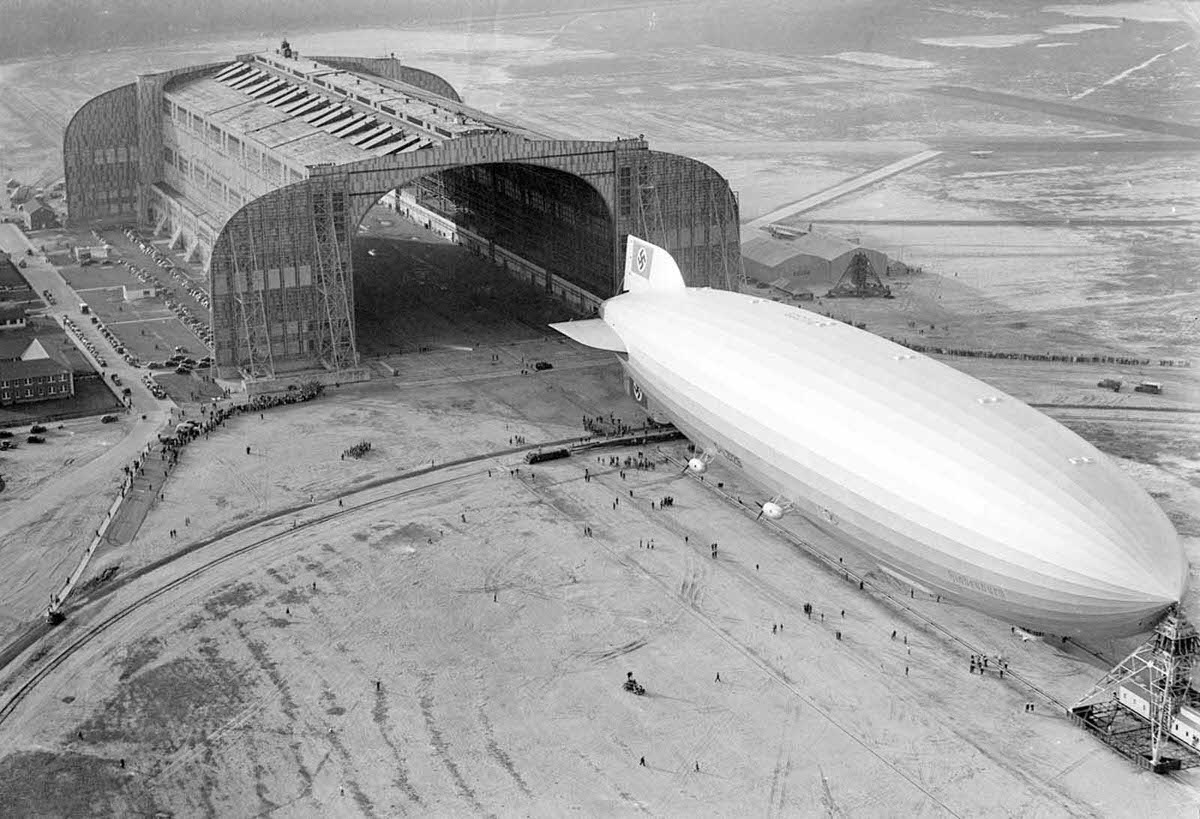
From an elevated vantage point, the German-built zeppelin Hindenburg glides toward the yawning mouth of the U.S. Navy hangar at Lakehurst, New Jersey, on May 9, 1936. Its immense, streamlined hull dominates the frame, while the hangar—an industrial cathedral of steel and timber—waits like a dock for an airborne ship. Tiny figures and vehicles on the ground underline the scale of this airship era, when distance could be conquered with spectacle as well as speed.
Near the nose, a mobile mooring tower serves as the crucial handshake between lighter-than-air technology and the infrastructure built to handle it. The careful choreography implied here—ground crews spaced out across the field, the airship aligned with the hangar doors—speaks to how much labor and precision were required to make zeppelin travel seem effortless. Seen in this moment of controlled arrival, the Hindenburg appears less like a curiosity and more like a mature machine at the center of modern transportation dreams.
Lakehurst’s hangar and the Hindenburg together form a striking portrait of 1930s innovation, combining daring aeronautics with military-scale engineering. For readers searching the history of zeppelins, early aviation, and the Hindenburg at Lakehurst, this photograph preserves a day when airship travel still felt like the future. The wide open field, the monumental architecture, and the silver cigar of the dirigible capture an age poised between romance and risk in the skies.