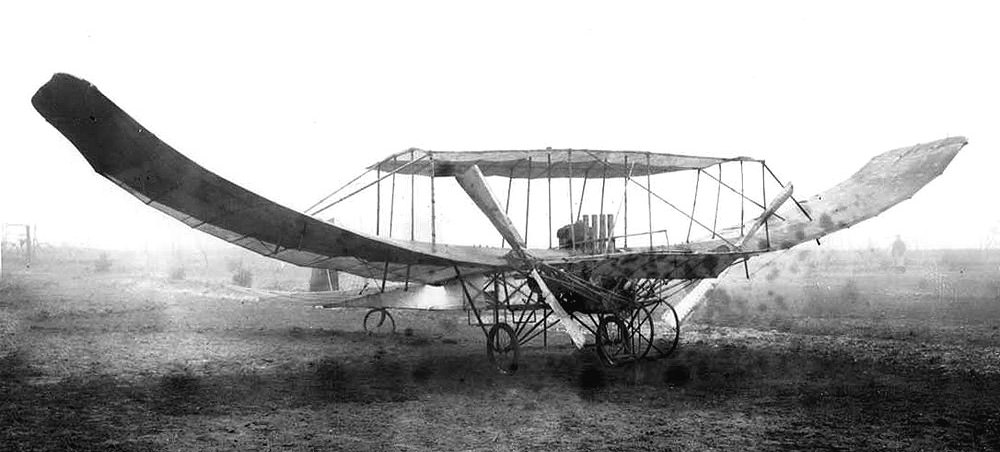
Oddly elegant and slightly precarious, the aircraft in “Robart 1908” sits low on spindly wheels, its long, fabric-covered wings stretching out like a glider and its frame laced with wires and struts. A boxy engine assembly and exposed mechanics hint at the experimental nature of early flight, when builders favored access and adjustability over streamlined shells. The open field behind it, hazy and empty, feels like the kind of testing ground where invention met risk head-on.
Every detail speaks to the inventive spirit of the era: the ribbed wing surfaces, the braced tailplane, and the skeletal fuselage that looks more like a workshop prototype than a finished product. Early aviation engineering relied on lightweight materials, tensioned rigging, and careful balance, and this machine makes those principles visible in a way modern aircraft rarely do. For readers interested in inventions and technological history, it’s a revealing snapshot of how aviation advanced through hands-on experimentation.
“Robart 1908” also invites the imagination to supply the missing sounds and motion—the sputter of an early engine, the creak of wood and fabric, and the anxious pause before a trial run. Photographs like this are invaluable for understanding the practical challenges faced by pioneers of flight, from stability and lift to the simple problem of getting a fragile craft across uneven ground. As a historical photo for a WordPress post, it’s rich with SEO-friendly themes like early aviation, experimental aircraft design, and the inventive culture of the early twentieth century.