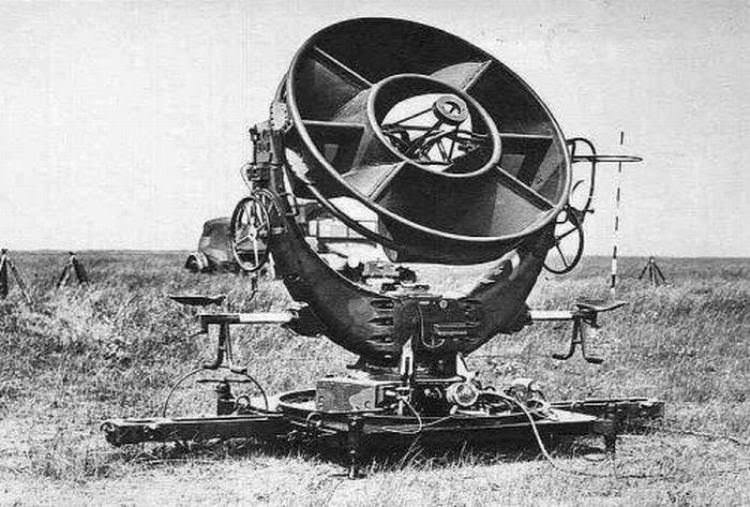
Dominating an open field, the German Ringtrichterrichtungshoerer (RRH) acoustic locator looks less like a weapon than a piece of experimental engineering—an oversized circular horn with internal vanes, mounted on a robust rotating base. Cables, adjustment knobs, and sighting aids hint at the careful calibration required, while the low platform suggests a system designed to be set up quickly and steadied against vibration. Even in still photography, the device conveys a sense of urgency: built to listen first, then point others toward what could not yet be seen.
Before radar became widespread, antiaircraft units relied on sound-ranging to detect and track aircraft at night, and RRH locators played a key role in that early warning chain. Operators would align the apparatus to the direction of incoming engine noise, then pass bearings to searchlight crews so the beams could be “walked” onto a target long before it was visible to the naked eye. The arrangement reflects a broader World War II battlefield reality—when darkness and distance favored the attacker, defenders answered with networks of instruments and trained ears.
Seen up close, the RRH stands as a reminder that World War II technology was not only about faster aircraft and heavier bombs, but also about increasingly sophisticated ways to sense the sky. Its ring-shaped collector and mechanical aiming system embody the transitional era between acoustic detection and electronic surveillance, when engineers pushed physics to its limits using metal, geometry, and human perception. For readers interested in inventions, military history, and WWII antiaircraft searchlight batteries, this photo offers a striking snapshot of how sound once guided light in the nightly contest above the front lines.