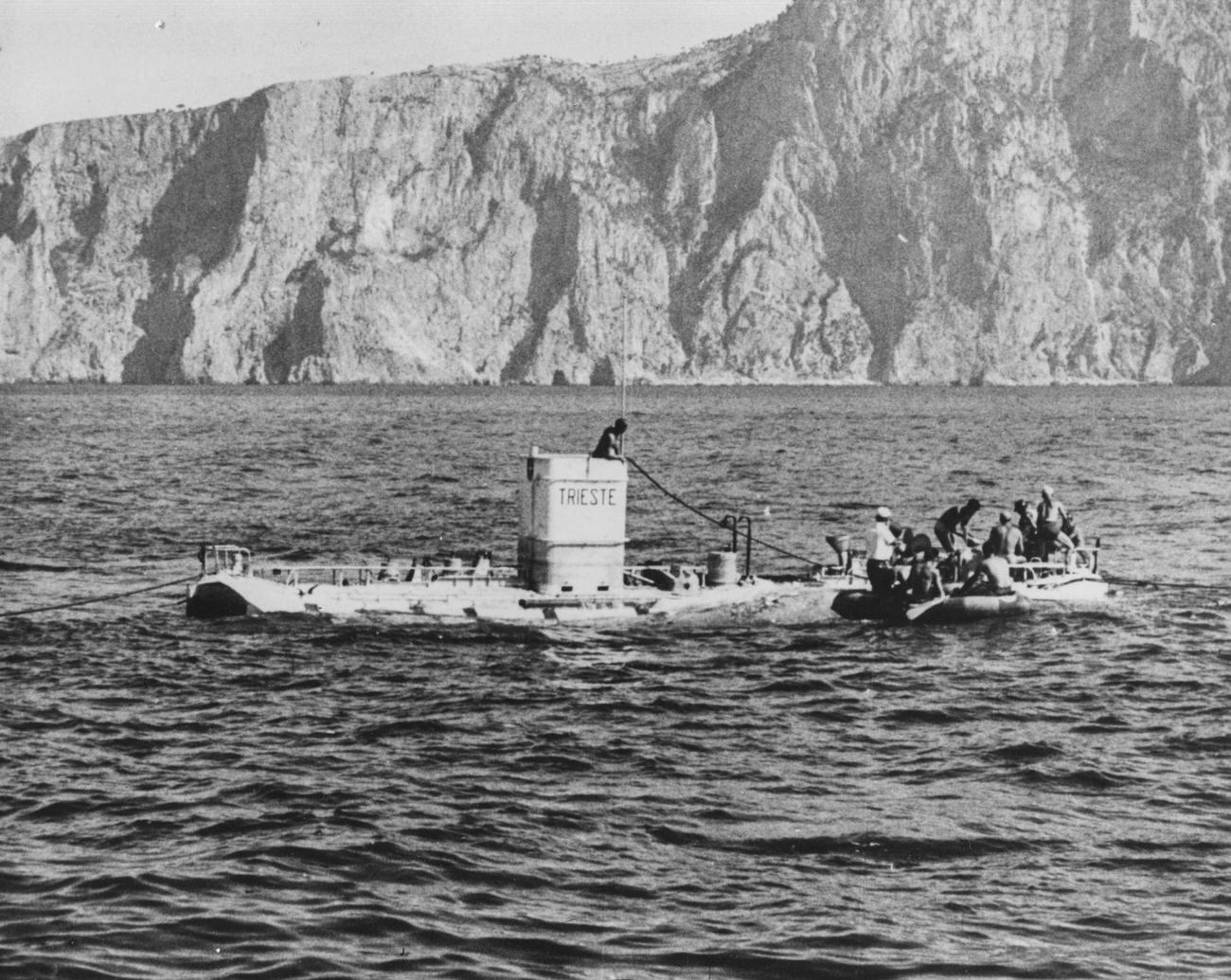
Against a wall of pale cliffs and an open sweep of sea, the bathyscaphe *Trieste* rides low at the surface, its compact conning tower marked clearly with its name. A small crowd gathers on the right, clustered around a modest boat drawn alongside, turning a monumental feat of engineering into an intimate, human-scale moment. The water looks restless, and the contrast between the vast landscape and the tiny figures underscores how exposed early deep-sea work could feel once the dive was over.
In 1953, Auguste and Jacques Piccard are shown boarding a rowing boat after surfacing, a practical transfer that hints at the realities behind ocean exploration: recovery, checks, and the careful choreography of support crews. The scene captures a transitional instant—between the hidden world below and the watchful eyes above—when experiment becomes reportage and invention becomes news. Details like the ladder, the clustered hands, and the low profile of the craft suggest the importance of teamwork in bringing pioneering underwater technology safely back.
For readers interested in the history of inventions, this photograph offers more than a portrait of a famous machine; it’s a glimpse of the working environment that made mid-century ocean science possible. *Trieste* stands as an icon of bathyscaphe design, and this surface-side vignette complements the better-known stories of record-setting depth by showing the everyday logistics that enabled them. As a historical photo for a WordPress archive, it pairs strong visual drama with high search appeal for topics such as Jacques Piccard, Auguste Piccard, bathyscaphe *Trieste*, and the early era of deep-sea exploration.