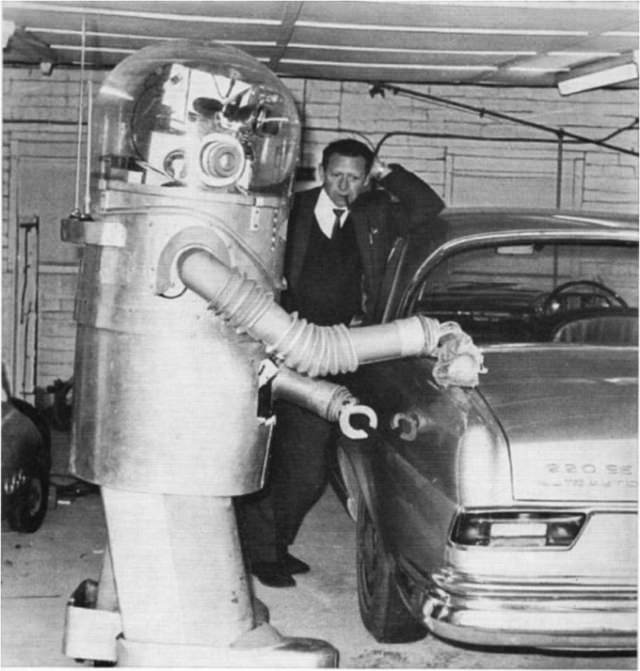
Inside a plain garage-like workshop, a bulky metal “housekeeper” robot named Tinker looms beside a parked car, its clear dome head and corrugated hose arms giving it the unmistakable look of mid-century science fiction made tangible. A man in a suit stands just behind, half shadowed by the open door, as if supervising a demonstration of the future arriving early. The scene is industrial and improvised at once—brick walls, overhead piping, and the kind of utilitarian space where ambitious inventions were tested on everyday chores.
Tinker’s stance suggests purpose: one claw-like hand near the vehicle’s bodywork while the flexible arms arc outward like tools waiting to be directed. That tension—between autonomous helper and machine that still needs human guidance—captures the era’s optimistic marketing of robotics as domestic labor-savers. In the 1960s imagination, a “real-life housekeeper” wasn’t a sleek android; it was a sturdy appliance on legs, built to scrub, polish, and handle tasks people wanted off their hands.
Stories like this are a reminder that the vision of the future has always been rooted in the practical: garages, prototypes, and show-and-tell moments meant to persuade the public that automation belonged at home. For readers drawn to retro technology, early robotics, and vintage invention culture, this photo offers a vivid snapshot of how 1966-era innovation was pictured—part engineering experiment, part household fantasy. The fascination still resonates today, as modern smart devices chase the same promise Tinker embodied: a machine that quietly does the work while life carries on.